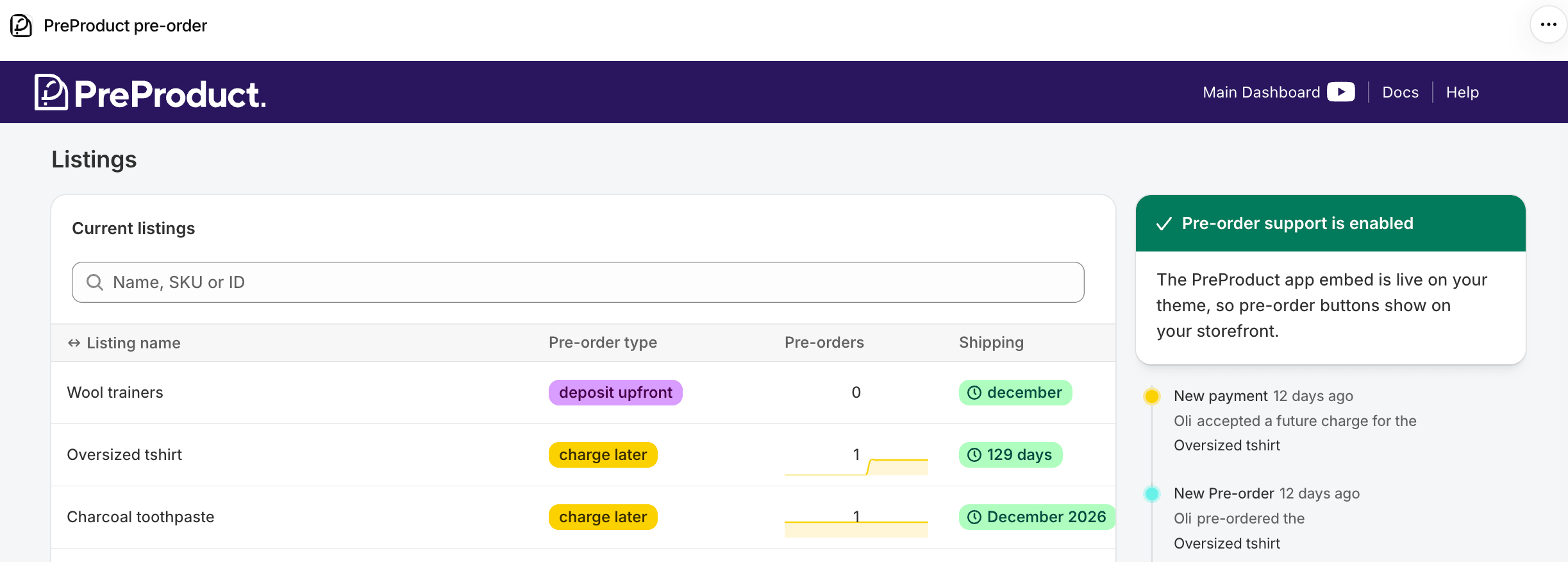
The PreProduct admin has been redesigned using Shopify’s Polaris design system, with every flow and screen layout kept exactly where you know it to be.
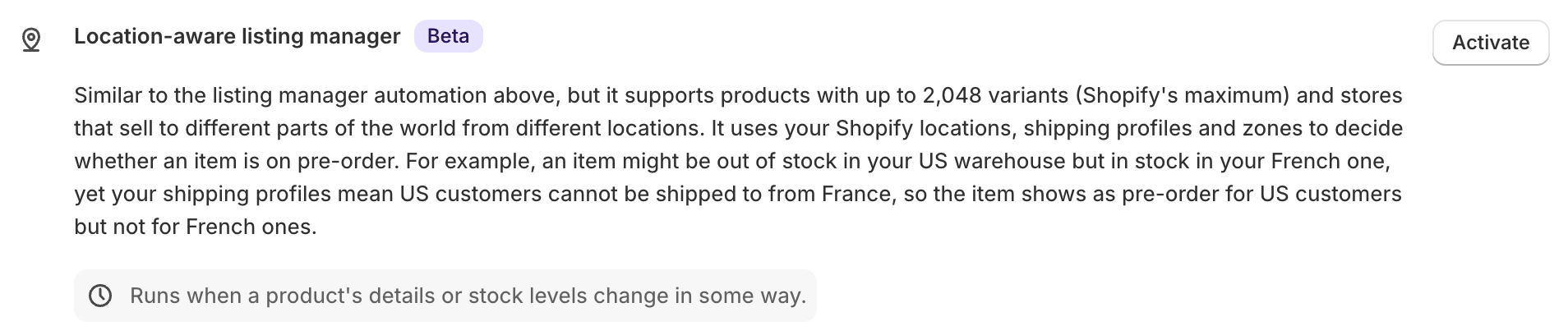
A new version of our location-aware listing manager automation sets per-location pre-order limits from incoming stock, the stock you already set through Shopify purchase orders and inventory transfers (beta).
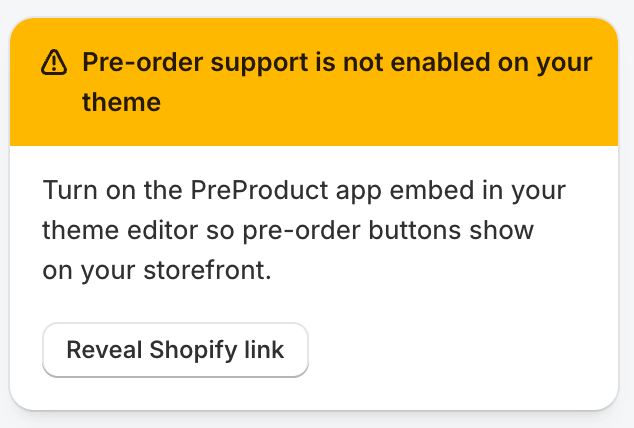
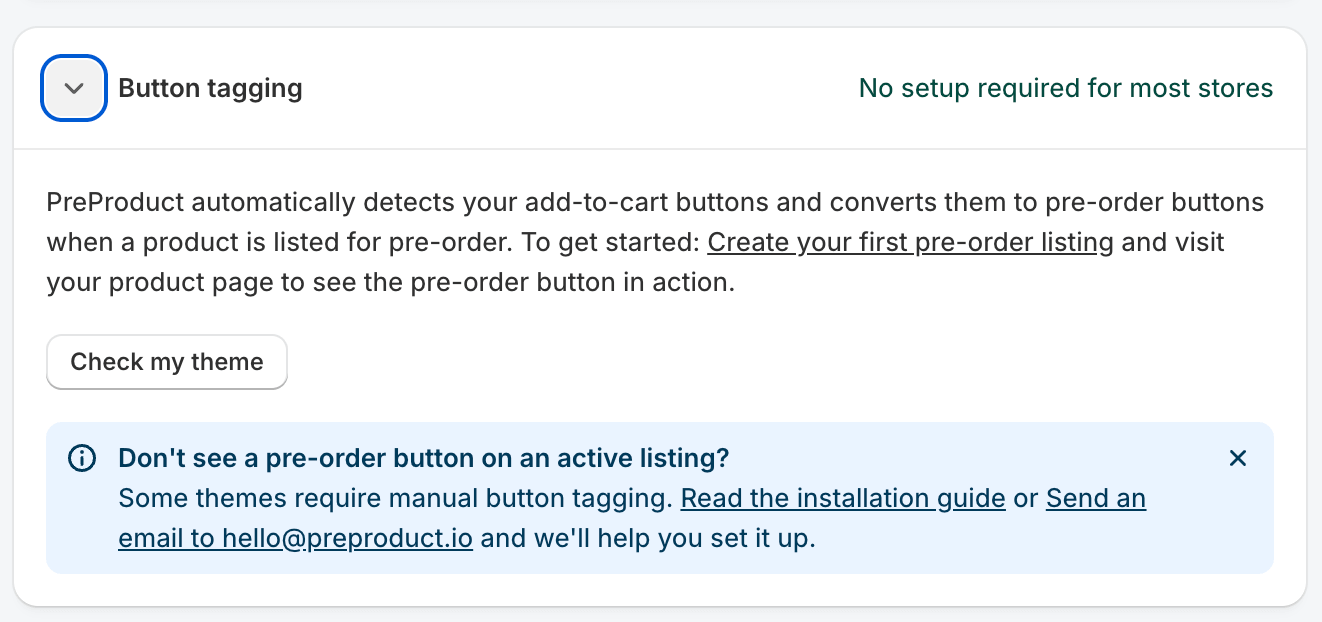
PreProduct now spots when its app embed is switched off on your theme, and you can check whether it recognises your buy buttons from the admin.
Introduction
This roundup covers what we’ve shipped since our last feature update, up to early October 2026, including the biggest visual change PreProduct has had in a long while.
We’ve redesigned the app on Shopify’s Polaris design system, and PreProduct now carries Built for Shopify status. Alongside that, multi-location stores can opt into managed pre-order limits based on their incoming stock, and PreProduct is better at telling you when something on your theme is stopping pre-orders from showing.
Here’s what’s new and what it means for your day-to-day.
PreProduct is now Built for Shopify
PreProduct now has Built for Shopify status. It’s the badge Shopify gives apps that meet its standards for performance, design and integration with the Shopify admin.
For you, it’s a signal that PreProduct works the way Shopify expects apps to work, fits naturally into your admin and is built with Shopify’s own building blocks. If you’re comparing pre-order apps, it’s an independent check from Shopify rather than a claim from us.
A redesign that keeps everything where you left it
We’ve rebuilt the PreProduct admin using Polaris, Shopify’s own design system. Buttons, forms, tables, badges, banners and save bars now look and behave like the rest of your Shopify admin.
Same flows, same layouts
We know you open PreProduct to get a job done, not to admire it. Redesigns that move things around are frustrating, especially mid-launch when you just need to update a ship date or check an order.
So we were strict about it. Every flow and every screen layout is where it was. Creating a listing, managing pre-orders, customising your front end and working through your setup all follow the same steps in the same places. What’s changed is the individual components on each screen, which are now sharper, more consistent and more familiar.
If you knew where something was last month, it’s still there.
What you’ll notice
A familiar look. PreProduct now matches the rest of your Shopify admin, so moving between Shopify and PreProduct feels seamless.
Clearer status at a glance. Listing stages and pre-order payment statuses use Polaris badges, so it’s quicker to see what’s active, paid or waiting.
Fewer lost changes. Settings pages use a Shopify-style save bar, so it’s obvious when you have unsaved changes.
Consistent forms and tables. Inputs, toggles and lists behave the same way on every screen.
Pre-order limits that follow your incoming stock (beta)
If you sell from more than one location, you may already use the location-aware listing manager, one of PreProduct’s automations. Once it’s switched on, it puts items on and off pre-order for you, using your Shopify locations, shipping profiles and zones to decide whether an item shows as pre-order for a given customer.
There’s now a second, alternative version of that automation: the Location-aware listing manager with max limits. It’s a separate automation rather than a change to the original, so nothing changes for you unless you turn it on. It does everything the original does, and also sets each variant’s pre-order limit at each location from its incoming stock, so you never pre-sell more than is actually on the way.
Driven by the stock you already track in Shopify
Most merchants already record incoming stock in Shopify, without thinking of it as a pre-order setting:
Purchase orders. Raise a purchase order to a supplier and Shopify records those units as incoming at the receiving location.
Inventory transfers. Move stock between locations and the units in transit show as incoming at the destination.
PreProduct reads that incoming stock and uses it as the pre-order limit for that variant at that location. When a new purchase order lands or a transfer is updated, the limit updates with it. No spreadsheets, no manual limits to keep in sync.
Is it right for your store?
This version is deliberately strict. A variant becomes pre-sellable at a location only when that location stocks it, it has run out of available stock and it has incoming stock on the way.
That means it only suits stores that already track incoming stock in Shopify, through purchase orders or inventory transfers. If a sold-out variant has no incoming stock recorded, PreProduct won’t let it go on pre-order at all. If you don’t use that side of Shopify, the original location-aware listing manager is the better fit.
Fine-tuning it
Reserve a percentage of incoming stock. Hold part of each incoming shipment back from pre-orders, for wholesale, retail or simply a buffer.
ERP-friendly mode. If your ERP or inventory system already reduces Shopify’s incoming quantity as pre-orders come in, switch this on so stock isn’t counted twice.
Where to find it
Go to Automations and look for Location-aware listing manager with max limits. It’s in beta, available for Shopify stores on our premium plans, and needs the latest app permissions.
Know when pre-orders can’t show on your storefront
When a pre-order button doesn’t appear, the cause often isn’t the listing at all. It’s the theme. Either PreProduct’s app embed has been switched off, which is easy to miss after a theme change, or PreProduct can’t find the theme’s buy buttons to switch over to pre-order.
PreProduct now helps with both.
Automatic app embed detection
On Shopify, PreProduct checks whether its app embed is turned on in your live theme. If it isn’t, you’ll see a warning on your listings dashboard telling you that pre-order support isn’t enabled on your theme, with a button that opens your theme editor with the PreProduct embed ready to switch on. Once it’s on, the warning turns green by itself.
That’s especially handy after publishing a new theme, when it’s easy to forget the embed doesn’t carry over.
Buy button recognition check
PreProduct works by taking over your theme’s existing add-to-cart buttons. A new Check my theme button opens a product page on your storefront and confirms whether PreProduct has recognised those buttons.
If it has, you’re good to go. If it hasn’t, you’ll know before a customer does, and you can email us so we can get it working with your theme. This check works on Shopify, BigCommerce and WooCommerce.
Wrapping up
This update is mostly about how PreProduct feels to use. Built for Shopify status and the Polaris redesign make PreProduct a natural part of your Shopify admin, without moving anything you rely on. Limits driven by incoming stock take another manual job off your plate for multi-location launches, and the new theme checks catch the quiet problems that stop pre-orders from showing.
As always, if anything doesn’t look or behave the way you expect after the redesign, reply to any of our emails and you’ll reach us directly.
TLDR: Holiday pre-orders are set by one date you don’t control: the last day your carrier can get a parcel there before Christmas. In 2026 that’s 17 December for USPS Ground Advantage, and your 3PL’s last pick date comes earlier still. Work backwards from it. Sort every product into “arrives before Christmas” or “ships in January”, then choose the charge, the wording and the Black Friday offer for each group. Charge upfront only for what can arrive in time. Charge later or take a deposit for anything shipping in January. Keep pre-order lines held at the 3PL all through peak.
Introduction
In October 2024 a merchant asked the Shopify Community for a pre-order solution for Christmas. They wanted in-stock and pre-order versions of the same products on sale side by side. After reading the replies, they settled on this:
“I think the best option, for now at least, is to add a separate variant to each product. As we have a number of staff it means that it is a relatively simple thing to train them on. I’ll also have a look at split shipping but this might complicate matters.”
That’s a workaround you manage by hand, product by product, in the busiest eight weeks of the year. It’s also the answer most stores end up with, because holiday pre-orders get planned in the wrong order. The product comes first, the offer second and the shipping date turns up in the week before Christmas.
This guide plans holiday pre-orders the other way round. You start with the date, then decide what to list, what to promise, when to charge and what to hold back from the warehouse. It’s written for the person whose managing the Q4 plan. That’s usually someone running Shop Pay, a set of Klaviyo flows and a 3PL that picks orders the minute they land. If you’re new to taking pre-orders at all, our guide to pre-orders on Shopify covers the setup. The store examples below all come from brands running PreProduct, our Shopify pre-order app.
Work Back From Your Last Ship Date for Holiday Pre-orders
Every decision in a holiday pre-order depends on one question: can this reach the customer by 25 December? You answer it from the calendar, not from how much stock you’d like to sell.
Christmas Shipping Cut-offs for 2026
USPS published its 2026 holiday shipping dates on 22 September. For delivery before 25 December within the lower 48 states, the recommended send-by dates are:
USPS service
Last send-by date (lower 48)
Ground Advantage
17 December
First-Class Mail
17 December
Priority Mail
18 December
Priority Mail Express
19 December
Ground Advantage to Alaska, Hawaii, Puerto Rico and US territories closes a day earlier, on 16 December. International dates are due on the USPS holiday page from mid-October, so check them then rather than guessing.
International matters more than it used to. Over Black Friday Cyber Monday 2025, 16% of orders on Shopify were cross-border. If you sell into several markets, you don’t have one last ship date for your holiday pre-orders. You have one per market, and the international ones fall earlier.
Your 3PL Cut-off Comes First
The carrier date isn’t your deadline. Your warehouse’s last pick date is, and it sits days before the carrier’s because the 3PL is clearing everyone else’s peak volume too. Ask your 3PL for its holiday cut-off now, in writing.
Then look at stock that isn’t in the building yet. Build buffer days into any holiday pre-order promise that depends on inbound stock: 7 to 10 days for a reliable domestic supplier, 14 to 21 for international freight. We explain the reasoning in our guide to pre-order purchase order management. A container due on 10 December is not a Christmas delivery.
Before-Christmas and After-Christmas Pre-orders
With those two dates you can sort every candidate product into one of two groups. This split drives everything else in this guide.
Confirmed stock lands
Group
What you promise
How to charge
Before your 3PL cut-off, with buffer
Before-Christmas pre-order
Arrives before 25 December
Upfront, or at dispatch
After your 3PL cut-off
After-Christmas pre-order
Ships in January
Charge later, or take a deposit
If a product’s confirmed stock ETA is close to the line, put it in the after-Christmas group. A promise you downgrade in October is a line in a product description. A promise you break on 22 December is a support ticket, a refund and a present that isn’t under the tree.
Charge Timing for Holiday Pre-orders
Charging is where most holiday pre-order plans go wrong. The instinct at peak is to take the money now. Whether that’s right depends entirely on which group the product is in.
It also helps to know that charging at checkout isn’t the norm for pre-orders. Across the first million pre-orders we’ve processed, only 25% were charged at day 0. Charging later is the standard way pre-orders run, not an edge case.
Arrives Before Christmas: Charge Upfront
For a before-Christmas pre-order, the wait is short and the stock is confirmed. Charging upfront is fine here and keeps things simple for the customer and for finance. You’re in good company: the same report shows 20.6% of pre-orders ship within 30 days.
If you want a margin of safety, use charge-later here too. The card is vaulted at checkout and you charge it when you dispatch. If stock slips past the cut-off, you haven’t taken money for a gift that won’t arrive.
Ships in January: Charge Later or Take a Deposit
For an after-Christmas pre-order, don’t charge in full in November. You’d be holding a customer’s money through December for something they can’t give on the day. A buyer who paid in full on Black Friday for a January delivery is the likeliest to email on 27 December asking for a refund.
Charge-later pre-orders solve this. The customer checks out once, the card is vaulted with Shopify and you charge when stock is ready to ship. Because the card is vaulted rather than authorized, there’s no authorization period quietly running out over the holidays.
For higher-ticket products, a deposit is the other good fit. Take a portion now to lock in the commitment, then charge the balance on the vaulted card when the product ships in January, by hand or with auto-charge on the Scale plan and up.
Trigger Charges by Hand or by Automation
Once you’ve picked a charge model, decide how the charge fires. For a single holiday drop with one stock delivery, triggering charges and releasing fulfilment by hand keeps you in complete control. You pick the day and the batch, and nothing happens until you say so.
If you’re running rolling restocks through Q4, with several SKUs landing on different days, hand it to automation. PreProduct’s auto-charge as stock lands (Scale plan and up) charges customers first come, first served when inventory is added in Shopify, then releases their fulfilment holds.
Holiday Pre-orders During Black Friday Cyber Monday
Black Friday falls on 27 November in 2026, and Cyber Monday on 30 November. That’s your Shopify BFCM weekend, when holiday pre-order listings meet your heaviest traffic and your biggest discount codes. Settle three questions about Black Friday pre-orders before it arrives.
Black Friday Discounts on Pre-order Lines
First, decide whether your sitewide Shopify Black Friday codes should apply to products on pre-order. Shopify discount codes stack on top of a PreProduct pre-order discount, whether or not you allow discount combinations in your Shopify discount settings. So if you run a 25% sitewide code alongside a pre-order discount, a pre-order line can get both. If that isn’t the offer you intended, change one of them before 27 November, and test it with a real checkout in October.
Then ask whether pre-orders need a discount at all. Most don’t: 90.4% of pre-order listings in our report carry no discount. A customer pre-ordering a January product during Black Friday is buying something they can’t get anywhere else yet. They aren’t comparing it with your in-stock markdowns.
Early-order Rewards Instead of Discounts
If you want a Black Friday reason to pre-order now, reward the early order instead of cutting the price. Jones Soda’s Nuka-Cola launch, one of our real Shopify pre-order examples, did this with a tiered reward:
“That means the first 1,500 units ordered will receive Edition One stickers. All remaining orders will ship with Edition Two stickers.”
Nobody is turned away. Late buyers still get a sticker, just not the first edition. The urgency is real and countable, and it costs pennies instead of 25% of the margin. For an after-Christmas pre-order during BFCM, a first-batch reward, free shipping or locked launch pricing does the same job as a code.
Mixed Carts at Peak
Black Friday is when a customer is most likely to put an in-stock gift and a January pre-order in the same basket. Scotch Porter ran a Black Friday countdown alongside this notice on a pre-order product page:
“If you check out with a pre-order item in your cart, your entire order will be held until that pre-order item is ready to ship. Place separate orders if you want in-stock items shipped right away.”
In gift season that sentence prevents the worst kind of ticket: “where’s the present I bought in November?” It tells the customer what to do, not just what will go wrong.
You have three choices here, and our guide to mixed cart pre-orders walks through them. 37.9% of stores in our report allow mixed carts; the rest isolate pre-orders into their own order. If you combine, Shopify’s split shipping shows the customer at checkout that the pre-order item ships separately, with its own shipping rate. Whether your 3PL can ship half an order and hold the other half needs testing before BFCM, not during it. If it can’t, isolating pre-orders with cart isolation is the safer choice for peak.
Fulfilment Holds Through Peak Season
During peak, your 3PL is picking more orders than at any other time of year, with temporary staff and less time per exception. A pre-order line that isn’t held either ships something that doesn’t exist yet or errors out in the warehouse. At peak, nobody has time to catch it before the customer does.
This is where holiday pre-orders go wrong for established brands. The offer, the page and the email flow are all fine. Then one January product slips into a pick list in December.
PreProduct puts pre-order lines on a fulfilment hold in Shopify automatically, so they don’t flow through to your 3PL or ERP until you release them. You release per listing when the whole batch lands, or per customer when you’re working through exceptions. Pre-orders also carry a tag and line-item property your warehouse or ERP can read, so they’re recognisable downstream. Our guide to managing pre-orders on your 3PL covers how each handoff works.
Before November, run one real mixed order through the whole chain: checkout, hold, 3PL, release, dispatch. You want to find out how your warehouse treats a held line in October.
It’s also worth keeping pre-orders on your own checkout. Shopify’s same BFCM 2025 figures show 32% of orders were placed with Shop Pay. Pre-orders that run through native Shopify checkout keep Shop Pay, your checkout extensions and the Klaviyo flows you’ve built for peak. If you sell into several markets, pre-order status can also be set per location on the Scale Plus plan, so a product sold out in Canada can go on pre-order there while it keeps selling from US stock. See multi-location pre-orders.
Gift-timing Wording for Holiday Pre-orders
In Q4, the customer’s question is “will this arrive in time?”, and your holiday pre-order wording has to answer it before they ask. It needs to change once, on a date you already know.
One rule first: the button stays a call to action. “Pre-order” goes on the button. The arrival date and the charge timing go in the message under it, the cart line and the confirmation email. For the exact copy, our guide to pre-order messages collects what a thousand stores actually write.
Before Your Cut-off
For before-Christmas pre-orders, name the date the customer cares about, not the date your stock lands. “Ships from 8 December, arrives before Christmas” answers the gift question. “Ships in 2 to 3 weeks” makes the customer do the arithmetic, and some of them will get it wrong. Repeat the same promise in the confirmation email, because that’s where gift buyers check when they start to worry.
After Your Cut-off
On your cut-off date, change the promise on every listing that can no longer arrive in time. Don’t leave “arrives before Christmas” on a product page on 18 December because nobody remembered to change it. “Ships week of 11 January” is honest, and plenty of gift buyers will still take it.
Give them something for the day itself. A printable note that says what’s coming, or a gift card, turns “it won’t be there” into “they’ll know it’s coming”. That’s a merchant decision about your own offer, and it keeps an after-Christmas pre-order giftable.
If you’d rather keep product pages clean, put the timing terms one click away. Gretchen Scott puts its pre-order terms in a pop-up next to the buy button.
That works well when a batch of listings changes its promise on the same day. Wherever the terms live, update ship dates in one place when a January date slips. The customer portal shows the new estimate, and an update email tells everyone who already ordered.
Q4 2026 Holiday Pre-order Calendar
Here’s the whole holiday pre-order plan on one page, working back from the dates above.
When
What to do
Now to mid-October
Sort products into before-Christmas and after-Christmas groups. Get your 3PL’s last pick date. Test one mixed order with holds, end to end.
Late October
List after-Christmas products on charge-later or deposit. Set how BFCM codes apply to pre-order lines, and test it. Write before- and after-cut-off wording.
Keep before-Christmas pre-orders open only while confirmed stock and your 3PL cut-off allow.
Your 3PL’s last pick date (before 17 December for USPS Ground Advantage)
Switch every remaining listing to January wording.
January
Stock lands. Charge and release fulfilment by listing, or let auto-charge run as inventory is added.
If you want the wider campaign structure around this calendar, our guide to running a pre-order campaign covers anticipation, launch and post-campaign review.
Frequently Asked Questions
Can I Take Pre-orders for Christmas on Shopify?
Yes. Holiday pre-orders on Shopify need a pre-order app, and the app handles the button, the charge and the fulfilment hold. The planning question is timing. Check each product against your 3PL’s last pick date and your carrier’s cut-off, and promise delivery before Christmas only where confirmed stock lands in time.
Should Pre-orders Get Black Friday Discounts?
Usually not. Most pre-order listings carry no discount at all. If you want a Black Friday reason to order now, reward early orders with a first-batch perk, free shipping or locked launch pricing instead of a price cut.
What Happens to Pre-orders Placed After a Shipping Cut-off?
They become after-Christmas pre-orders. On your cut-off date, change the wording on every affected listing to a January ship date. Consider giving gift buyers a printable note or gift card for the day, and charge when stock is ready to ship rather than at checkout.
Should I Charge Holiday Pre-orders Upfront?
Only for pre-orders that will arrive before 25 December. For anything shipping in January, charge later on a vaulted card or take a deposit. That way you aren’t holding the full amount through the holidays for something the customer can’t give on the day.
Planning Holiday Pre-orders Backwards
Holiday pre-orders go right when the plan starts from the date and goes wrong when it starts from the product. The short version:
Find your real deadline. Your 3PL’s last pick date comes first, then the carrier cut-off: 17 December for USPS Ground Advantage in 2026, earlier for international.
Split your products into two groups. Before-Christmas pre-orders promise arrival. After-Christmas pre-orders promise January.
Charge to match. Upfront or at dispatch before Christmas. Charge-later or a deposit for January.
Reward early orders at BFCM instead of discounting pre-order lines.
Hold pre-order lines at the 3PL through peak, and test a mixed order in October.
Q4 comes down to one question per product: when does it actually arrive? PreProduct lets you answer it per listing. Choose how each pre-order is charged, keep pre-order lines held until you release them and keep your Shopify checkout exactly as it is.
TLDR: Mixed cart pre-orders happen when a customer puts an in-stock item and a pre-order item in the same basket. You get three options: isolate pre-orders into their own order, combine and ship the in-stock half now, or combine and hold the lot until the pre-order lands. Two questions decide it, in order. Can your 3PL or WMS actually split an order, and how long is the customer waiting? If you have long lead times and can split cleanly, splitting is the best answer available. If your flow can’t do mixed fulfilment and lead times are long, isolate. Across the first million pre-orders we’ve processed, 62.1% of stores keep pre-orders out of mixed carts.
“How do I prevent customers from adding an instock item and a pre order item into the same cart? … This is so that we can move in stock items out of the warehouse rather than hold onto them until pre order stock arrives.”
Five years on, that thread still has no replies.
It isn’t an unusual question. The same forum board carries a handful of near-identical ones, all with reply counts in the single digits. What makes it worth answering properly is the reason given. This isn’t a tidiness problem. It’s a pallet of goods that could have left the building today, sitting still because one line on the order isn’t ready.
Mixed cart pre-orders are the decision you make once, ideally before the orders start arriving rather than after your 3PL calls. This guide covers what a mixed basket does to an order, the three ways to handle it, and the two questions that decide which one is yours to pick. Then what changes downstream in your warehouse, your ERP and your charge schedule.
What Mixed Cart Pre-orders Do to an Order
Shopify will take the order without complaint. It doesn’t separate products by availability, and there’s no native rule stopping a customer adding a September delivery and a today delivery to the same basket.
So one checkout produces one order with two ship dates on it. In your admin that looks harmless. The problem starts one system further down, at whatever picks that order up.
A 3PL or ERP syncing orders out of Shopify sees a single order and treats it as a single job. Unless something tells it otherwise, one of two things happens. Either it ships the in-stock line and flags the pre-order line as missing stock, leaving an exception for your ops team to clear manually. Or it waits for the whole order to become fulfillable, and your in-stock goods sit on the shelf for as long as the pre-order takes.
That second outcome is the expensive one, and for a lot of stores it’s the only one on offer. You’ve sold something you have, taken the money for it and then chosen not to ship it, for reasons the customer never agreed to.
Which is why mixed carts come up more often in ops conversations than marketing ones. The upside is real, customers spend more when they can add to a pre-order. But the cost lands in a different department to the benefit.
Three Ways to Handle a Mixed Cart
There are three workable answers. Every store lands on one of them, whether deliberately or by default.
Isolate: Keep Pre-orders in Their Own Order
An isolated pre-order cart never shares a basket with in-stock items. A customer buying both checks out twice.
Operationally this is the clean one. Every order is either all pre-order or all ready to ship, and nothing gets held that didn’t need holding. The cost is at the till: a second checkout is friction, and you lose the attachment sale a mixed basket would have picked up.
Isolation works by redirecting the pre-order click, and PreProduct offers four front-end redirect options, two of which isolate. Front-end rules leak though, through a third-party upsell app, a cart permalink or a stray buy button left in a theme, so the same rule is enforced inside Shopify’s own checkout code. A rule that only exists in your theme isn’t a rule.
Combine and Split: Ship the In-Stock Half Now
Allow the mixed basket, then treat the two halves differently after checkout. The pre-order lines get held, the in-stock lines ship today.
Best customer experience, best AOV, and the most demanding of your operations: you pay to ship twice, and every downstream system has to understand that half an order is deliberately not moving. It’s also the option you don’t always get to choose, because plenty of fulfilment stacks can’t ship half an order at all.
Combine and Hold: Ship It All Together Later
Allow the mixed basket and hold everything until the pre-order is ready, then send one parcel.
One shipping charge, one pick, no partial fulfilment logic to build. It’s the simplest way to say yes to mixed carts, and it’s the option that makes the 2021 forum question inevitable, because the in-stock goods are now hostage to the slowest line on the order.
How to Choose: Can You Split, and How Long Is the Wait?
Most articles present this as a balanced trade-off between average order value and operational sanity. It isn’t, quite. Two questions decide it, and the order matters, because the first one can remove options the second would have chosen.
First: Can Your Fulfilment Flow Split an Order?
This is the gate, and it’s the question the rest of the internet skips. Combining only works if something downstream can send half an order and leave the rest alone.
A lot of 3PLs, warehouse management systems and in-house fulfilment processes treat an order as one indivisible job: it either goes or it doesn’t. Partial fulfilment is often either unsupported, or supported in the admin but not in the integration your warehouse works from. Our guide to managing pre-orders on your 3PL, covers which providers handle it natively and which need a workaround.
Payment model narrows it again. Splitting a Shopify order cleanly is straightforward when the pre-order was charged upfront, because the money is already collected and each half can carry its own charge and its own shipping. When the pre-order line is still unpaid, you’re dividing an order where part of it has no payment attached, and that’s where splits stop being clean.
If your flow can’t split, combining means holding, whatever the lead time says.
Then: How Long Is the Customer Waiting?
The figures from our first million pre-orders set the stakes. The most common shipping timeframe is 121 to 150 days, covering 28.1% of pre-orders. Holding a t-shirt someone bought today for four months so it can travel with a jacket isn’t a fulfilment policy, it’s a support ticket with a delay built in.
Only 20.6% of pre-orders ship within 30 days. That’s the band where holding everything is defensible, because “we’ll send it all together in a few weeks” is a sentence a customer will accept.
Putting the Two Together
Long lead time, and you can split. Split, without hesitation. This is the best outcome on the table: the average order value of a mixed basket, and the in-stock goods still leave today. If your stack supports it, take it.
Long lead time, and you can’t split. Isolate. Holding stock for four months to keep one parcel together isn’t a trade-off, it’s a slow-motion complaint, and combining without the ability to split is how you get there.
Short lead time. Lower stakes either way. Combining and holding is reasonable, and splitting costs a second shipping charge for a couple of weeks of benefit. Margin usually decides it: high-ticket categories absorb the extra shipment, consumables don’t.
Across the dataset, 62.1% of stores keep pre-orders out of mixed carts. That’s 4,757 of 7,658 stores making the same call, which is worth reading as reassurance rather than as a constraint. Isolating isn’t the timid option or a stepping stone to something better. For most stacks and most lead times it’s the correct answer, and you can always relax it later once split fulfilment is something your operations handle without thinking.
Split Shipping on Shopify: What Happens if You Combine
If you allow mixed baskets, Shopify split shipping is the mechanism you’ll be working with, so it’s worth knowing how it behaves before you switch anything on.
Pre-orders are one of the order types Shopify explicitly splits. Per Shopify’s documentation, fulfilment divides into multiple shipments when a cart contains pre-orders, subscriptions, products shipping from different locations, products on different shipping profiles, or Buy with Prime items. The setting sits under Settings, then Shipping and delivery.
Pricing follows your location grouping: one flat rate within a location group, charged per shipment across different groups or shipping profiles. That second case is where the customer sees two shipping lines and your margin takes the hit.
Four constraints matter if you’re running a customised Plus checkout:
Accelerated checkouts are excluded. Split shipping isn’t available for accelerated checkout buttons, so the Shop Pay and express routes your customers actually use behave differently to the standard flow.
Customers can’t choose the grouping. They can pick methods per shipment, but not how their basket is divided.
Shipping Scripts can’t access it. Any custom rate logic you’ve built there won’t see the split.
Some third-party fulfilment apps aren’t compatible. Shopify’s own guidance is to test with eligible items or check with the developer first.
That last one is the one to take seriously, because it’s the one you discover during a launch rather than during setup.
What Your 3PL and ERP Do With a Half-Held Order
This is the part the rest of the internet skips, and it’s the part that determines whether combining works.
The reason a mixed order is dangerous isn’t the sale, it’s what happens next: an order containing something you can’t ship walks into the same pipeline as everything else. The fix is to make the two halves legible to systems that were never told about pre-orders.
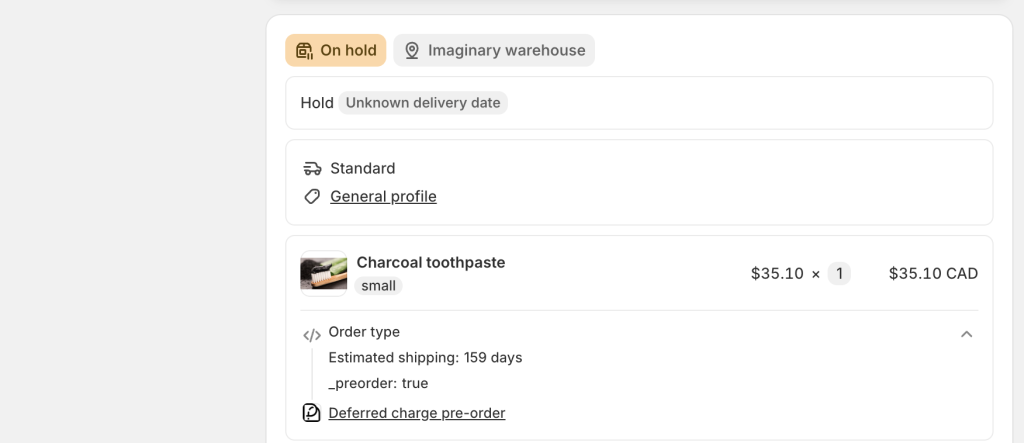
With PreProduct, a pre-order line item lands with an on-hold fulfilment status while the in-stock lines read as unfulfilled and stay free to go. On hold is a native Shopify state rather than a flag your app invented, so any system reading Shopify order statuses can understand it and skip those lines. You release fulfilment when you’re ready, by listing, by customer or by variant.
Whether a given system respects it is something to test, not assume. Plenty don’t. Some skip held lines out of the box, some need a routing rule written before they behave, and a few will pull the order whatever its status says. It varies by provider and by how the integration is configured, so this belongs on the pre-launch checklist right next to the split question.
Which is what the tag and the line-item property are for. Every pre-order order carries a pre-order tag and each pre-order line carries its own properties, so a system that ignores fulfilment status can still filter on something. Our controlled overselling page covers holds, tags and the Flow triggers for handing off to a warehouse or ERP.
If your stack cleared the split test earlier, you can go further and divide a mixed order into two orders after checkout, on charge-upfront pre-orders. The original keeps the ship-now items and the payment, the new order holds the pre-order items, and the two are linked by tags and notes. Each half then carries its own shipping charge and its own lifecycle. A few line-item types block the split and leave the order mixed, gift cards, bundles and import duties among them, with the reason logged on the pre-order. The splitting orders documentation covers the compatibility detail.
Charge timing came up as a constraint on splitting. It’s worth a section of its own, because it changes the mixed order after checkout too, not just your ability to divide it.
If everything is charged upfront, the mixed order is purely a fulfilment problem. Money is collected, and the only question is what leaves the warehouse and when.
If the pre-order line is charge-later, it’s a billing problem too. One order now carries a line that’s paid and a line that isn’t, with a charge firing weeks or months after the card details were captured. That’s the common case rather than the exotic one. Only 25% of pre-orders are charged at day 0, so three quarters of the time a mixed basket means a split payment timeline as well as a split ship date.
Two things follow. The customer needs to understand that the amount on their confirmation isn’t the total they’ll pay, and your finance side needs the pre-order revenue to land in the right period. Both are easier when the pre-order sits in its own order rather than tangled with a paid one, which is one more reason isolating keeps winning. Our charge later guide covers the deferred charge mechanics in full.
Telling Customers Before They Check Out
Whichever option you pick, the customer needs to know before they pay, not after.
Scotch Porter do the loud version well. Below a full-width pre-order button, the product page carries this:
“⚠️ PRE-ORDER NOTICE (Beard Oil + Beard Balm Only): These items must be purchased in a separate order.”
“If you check out with a pre-order item in your cart, your entire order will be held until that pre-order item is ready to ship. Place separate orders if you want in-stock items shipped right away.”
What makes it work is the last sentence. It tells the customer what to do, not just what will go wrong. A warning with an action attached reads as helpful; the same warning without one reads as a deterrent. It also sits below the call to action, so it informs without blocking.
Gretchen Scott take the opposite approach and it’s equally valid: a clean product page with the pre-order terms one click away in a pop-up. Loud on the page, or deferred to a pop-up, both put the terms in front of the buyer before checkout. That part isn’t optional.
One thing to keep straight: the button itself stays a call to action. “Pre-order” is the button; the ship-date and charge-timing answers belong in the wording around it. If you want the copy worked out for you, we’ve collected what a thousand stores actually write in our guide to pre-order messages.
Frequently Asked Questions
Can Customers Buy Pre-order and In-Stock Items Together on Shopify?
By default, yes. Shopify doesn’t separate products by availability, so a customer can put a pre-order item and an in-stock item in the same basket and check out once. Preventing it requires a pre-order app that enforces isolation, ideally at checkout as well as on the storefront.
How Do I Stop Pre-order and In-Stock Items Sharing a Cart?
Redirect the pre-order click into an isolated cart or a pre-order-only checkout, then enforce the same rule inside Shopify’s checkout so it holds when a customer arrives by another route. PreProduct handles both through its cart isolation settings.
Will a Mixed Cart Delay My In-Stock Items?
Only if you hold them, and that isn’t always a choice. A mixed order can be set up so the pre-order lines are held and the in-stock lines ship immediately, but this depends on your 3PL or WMS supporting partial fulfilment. Where it doesn’t, most systems wait for the whole order to become shippable, which delays goods you already have.
Does a Mixed Cart Get Charged Shipping Twice?
It can. With Shopify’s split shipping active, items from different location groups or shipping profiles are charged per shipment. Items from multiple locations in the same location group attract a single flat rate.
Do Mixed Carts Increase Average Order Value?
They tend to, because customers add in-stock items to a pre-order they were already making. Whether that gain survives a second shipping charge and the extra fulfilment handling depends on your margin and your 3PL.
Making the Call
Mixed cart pre-orders look like a customer experience question and behave like an operations one. That’s why the decision is worth making on purpose rather than discovering it during a launch.
The short version:
Check whether you can split before anything else. Many 3PLs and WMS platforms can’t ship half an order, and an unpaid pre-order line is harder to split cleanly than a paid one. That answer removes options before lead time gets a say.
Long lead time and a stack that splits? Split. You keep the mixed-basket order value and the in-stock goods still go out today.
Long lead time and a stack that doesn’t? Isolate. Holding stock for months to keep one parcel together is a complaint waiting to happen.
Isolating is the normal choice, and 62.1% of stores make it. It isn’t a compromise.
Tell the customer before checkout, and give them an action rather than just a warning.
If you want the decision to be a setting rather than a project, that’s what PreProduct’s cart isolation and mixed order handling does. Four ways to route the pre-order click, the same rule enforced inside Shopify’s checkout, and per-line fulfilment holds when you’d rather combine. As STRAYE put it: “Pre-Order isolation was key for us, and they pulled it off.”
TLDR: Eleven real Shopify pre-order examples, grouped by the decision each brand made rather than by industry. Jones Soda built a themed landing page for a $49.99 soda and gives the first 1,500 orders a better sticker. Dalstrong sold a $1,499 axe on a countable limit of 20 with a choice of payment models. Scotch Porter and Gretchen Scott disclose pre-order terms in opposite ways, and both work. Sirius Dice had 22 pre-order listings live at once, which looks less like a campaign than a default setting. Pick the one that fits your next product.
Introduction
Most round-ups of Shopify pre-order examples show you sixteen product pages in a row and tell you to add a countdown timer. The screenshots are usually fine. The grouping isn’t: by industry, or one brand after another. Four fashion brands all “using social proof” teaches you the same thing four times.
This piece is grouped by the decision instead. Each example is from a real pre-order campaign where the merchant made a different call: how specific to be about the ship date, what to offer for ordering early, and how specific to be.
Eleven brands, eleven decisions. Some will fit your product and some won’t, which is the point.
Most of these campaigns ran on our own pre-order platform, so the detail is first-hand: exact on-page copy, real payment models and lead times. Finished campaigns are described in the past tense.
How real brands use pre-orders: 11 Shopify pre-order examples at a glance
#
Approach
Brand
Use it when
1
Tailor-made launch landing page
Jones Soda
The launch is an event, not a restock
2
Licensed collab storytelling
Away
You’re borrowing another audience
3
Reward tier instead of a discount
Jones Soda
You want urgency without capping supply
4
Countable limited allocation
Dalstrong
Scarcity is real and you can state the number
5
Batch selling as the model
Paynter
Scarcity is structural, not a tactic
6
Loud on-page disclosure
Scotch Porter
Mixed carts could cause support headaches
7
Clean page, terms in a pop-up
Gretchen Scott
Brand aesthetics matter as much as clarity
8
Deposit to lower commitment
Perk Supply
The product is untested or high-ticket
9
Lower-commitment language
Matias Moellenbach
Price alone causes hesitation
10
Reviews and UGC carrying the risk
Tinge Beauty
You have history on the product line
11
Pre-order as a default state
Sirius Dice
You have continuous inbound stock
Build the entire page around the launch
Jones Soda x Nuka-Cola: a themed environment, not a product page
The hero does no selling at all. It builds a world: space background, Vault Boy, custom display type, product art directed to match the Fallout universe. The commercial work happens further down, where the buy module carries the terms.
Two details are worth copying. The pre-order policy is linked by name at the point of purchase rather than buried in the footer: “By purchasing this item you are acknowledging you have read and agree to our Pre-Order policy.” And the ship date is a specific month, October 2026, not a vague quarter.
If you’re building the page itself, we’ve covered layout and hierarchy separately in our guide to pre-order landing page examples. This section is about the decision to give a launch its own environment in the first place.
Away x The White Lotus: borrow an audience, borrow its visual language
Away’s collaboration with The White Lotus took the idea further, adopting the show’s illustrated art direction instead of Away’s usual product photography. It opened with “LIFE IS SHORT… JUST TAKE THE TRIP.” and a second panel of pure storytelling, the luggage almost incidental.
The collection has since sold out, and that state was left live pointing at new arrivals. A finished drop still works as proof that drops sell out.
Make the incentive something that isn’t a discount
The reflex, when you’re asking someone to wait, is to knock money off. Most merchants resist it. According to our report on over One Million pre-orders, only 9.6% of pre-order listings carry any discount at all, and the most common band, 5% to 10%, applies to just 5.3% of listings.
That leaves a better question than “how big a discount do I need to offer?” it’s “what can I give early buyers that doesn’t cost me margin?” Jones Soda has the sharpest answer here.
Jones Soda’s tiered sticker reward
Jones Soda’s answer:
“We reserved a limited number of Edition One stickers to account for incidentals, and a few are still available. That means the first 1,500 units ordered will receive Edition One stickers. All remaining orders will ship with Edition Two stickers.”
Look at what that does. Nobody is turned away. A capped drop creates urgency by refusing customers; a reward tier creates urgency while still taking every order. The margin cost is a sticker, and the scarcity is specific, so nobody has to be disappointed.
The generalisable rule: tier it rather than gate it, and state the number. “The first 1,500 units” is urgency. “A limited number” is not.
Three other ways to pay for commitment
Free shipping attached to a payment choice. Dalstrong offered two radio buttons on its Gene Simmons Hellfire Demon Axe: “Pay 20% now to secure your order” or “Pay in full to unlock free shipping.” Both cautious and committed buyers get an option, and neither involves cutting the price.
Price protection.Perk Supply tells early buyers that “reserving locks your launch-price spot.” The reward is certainty, not a saving.
A stacked, frictionless saving.Obsidian Adventure Gear is the outlier that does discount: “Submit your pre-order now and save $30 plus free US shipping. Discount auto-applied at checkout.” Note the framing. It reads as a reward for committing early, not a markdown, and there’s no code to hunt for.
Obsidian’s page is also a reminder that pre-orders aren’t only for launches. “New Inventory arrives late August” frames this as a restock, which is a far more common use case than the launch-day drops most articles fixate on.
Use scarcity a customer can actually count
Dalstrong: “Limited Edition: 20 Available for Pre-Order”
The Dalstrong KISS collaboration was a $1,499 item, and its buy box did more work than any other here. Alongside the payment choice it stated “Limited Edition: 20 Available for Pre-Order” and “Limit 1 per customer”, declared the 20% deposit non-refundable in plain sight, and broke the bundle into named components.
“20 available” is scarcity a customer can verify. “Limited edition” on its own is a claim. The difference matters more than the wording of the button.
Paynter: when scarcity is the business model
Paynter sells in numbered batches. Batch no.22 sold out, and the page still worked by pointing at the next one. Because the constraint is structural rather than a marketing device, Paynter never has to manufacture urgency. Customers know the rules.
Say the awkward part out loud, in one of two ways
Every pre-order has an uncomfortable truth attached: the customer is paying for something they can’t have yet. Two brands in this library handle it in exactly opposite ways, and both are right.
Scotch Porter: the unmissable on-page warning
Scotch Porter put a warning block directly under its pre-order button:
“PRE-ORDER NOTICE (Beard Oil + Beard Balm Only): These items must be purchased in a separate order. If you check out with a pre-order item in your cart, your entire order will be held until that pre-order item is ready to ship. Place separate orders if you want in-stock items shipped right away.”
This is the mixed-cart problem stated in the customer’s own language, at the moment of decision. Most stores discover it at support-ticket time instead. 37.9% of stores allow mixed carts, and those that do inherit exactly this conversation.
The reason it doesn’t kill the sale: the warning tells the customer what to do, not just what will go wrong. That reads as helpful rather than as a deterrent, and it sits below the call to action, so it informs without blocking.
Worth saying that asking politely is the fallback, not the only option. Scotch Porter is relying on the customer reading the notice and choosing to place two orders. A more capable app decides it for them. PreProduct’s front-end redirects offer two settings: send the shopper straight to checkout, so a pre-order can never share an order with in-stock items, or send them to the cart, where several pre-order items travel together but buy-now items are kept out.
Which you want depends on the trade-off inside that 37.9%. Isolated carts are cleaner to fulfil and avoid charging shipping twice on an order that ships in two parts. Mixed carts protect average order value. Allow mixing and you need the Scotch Porter notice; enforce isolation and you don’t.
Gretchen Scott: keep the page clean, put the terms one click away
Gretchen Scott takes the opposite view. The product page is deliberately unremarkable: standard photography, colour and size selectors, and a single black “Preorder” button where “Add to cart” would normally sit. No banner, no badge, no warning block. A shopper browsing the catalogue sees a normal fashion page.
Clicking the button opens a pop-up that carries everything the page omits, in one sentence of plain language: “We expect the So Sweet Dress will ship in September 2026. Preorder today and we’ll hold off charging you until we’re ready to ship.” There’s a quantity stepper, a “+” to add more pre-order items to the same reservation, and an optional note field that catches sizing questions at the point of order.
Neither brand hides anything. They differ on when the buyer sees it. If your brand lives on visual restraint, defer the terms. If your logistics create a real surprise, put it on the page. What doesn’t work is leaving it to the confirmation email. For the wording itself, we’ve collected pre-order message examples and templates drawn from over a thousand stores.
Perk Supply’s buy box shows £19.99 struck through, replaced by “Deposit, £5”, with “Balance only charged when we ship” underneath. In red beneath the button: “Limited to our first pre-order test batch, reserving locks your launch-price spot.”
A deposit on a £19.99 consumable is unusual, and that’s the interesting part. It isn’t there to spread cost. It’s there to lower the commitment on an untested product, and Perk says so openly by calling it a test batch. Honesty about the campaign’s purpose is itself a trust signal.
The Interpolate Chair uses “Reserve now” rather than “Buy”. It reframes the transaction as holding a place rather than parting with money. On high-ticket, long-lead items, the language of commitment matters as much as the amount does.
Let other customers carry the risk
Tinge Beauty: reviews from shipped batches de-risk the next one
Tinge’s pre-order page leads with a 4.35 out of 5 rating from 79 reviews, a customer video review and a photo strip, plus “free + easy returns, always” in the top bar. The price sits inside the button: “pre-order | $44.00”.
This is why a repeat pre-order converts better than a first one. Reviews from previous batches answer the question a new buyer can’t otherwise resolve: does this thing work? A shade quiz does the same job a measurements table does for apparel, reducing returns on an order that won’t arrive for months.
Long Table Pancakes: ride a live press moment
After appearing on Shark Tank, Long Table renamed the product “As Seen on Shark Tank Variety Pack”, which is exactly what people typed into search after the episode aired. The page carried the pull-quote “BEST PANCAKES I’VE EVER HAD” with the investors named and the air date given, so the claim was checkable.
The operational half is what most brands skip. An announcement bar read “Where is my order? >>Shipping schedule & Shark Tank update<<“, and the PDP framed demand overflow as proof rather than apology: “You blew up our spot! 10,000 orders and counting.” Naming it “Round 2” set the expectation that batches repeat. Our pre-order campaign framework covers the phases in detail.
A growing number of brands handle that same update through a push notification instead of a banner. A mobile app builder like Apploy lets a Shopify store send shipping and status updates straight to a customer’s phone, which cuts down on the ‘where is my order’ messages a long pre-order wait tends to generate.
Run every restock and purchase order through a pre-order stage
Every example so far is a campaign: a launch, a drop, a moment. Sirius Dice looks like something else, and it points at the most under-covered idea in this category.
What’s visible from the outside: 22 pre-order products live at once, a permanent “Coming Soon” collection in the navigation, and the same boilerplate line on every listing (“…is a pre-order item to be released at a later date. It will be shipped once the item is available.”). Inventory state shows as “Backordered” under the button, consistently everywhere the product appears.
We can’t see their purchasing calendar, so we don’t know whether that’s policy or just how things have settled. It doesn’t read like a campaign though. No countdown, no hero treatment, no launch moment. Pre-order looks like a normal state for a product to be in.
That’s the model worth borrowing, whether or not anyone set out to build it: treat a pre-order stage as the default for upcoming products and restocks, rather than deciding case by case. The argument for it:
The sell window opens when the purchase order is placed, not when stock lands. Every week a new release sits unannounced is a week of demand going nowhere.
Out-of-stock pages stop being dead ends. A licensed range has continuous new sets and restocks. The alternative is a sold-out page converting at zero.
Demand signal arrives before the reorder. Pre-order volume tells you how deep to go on the next purchase order, before committing cash.
It compounds. Customers learn where to reserve the new set, which is what makes the next launch bigger.
The operational point is what makes it possible. At that many live listings, ship dates and charge timing can’t depend on someone remembering to write them into a description. A boilerplate line plus consistent button treatment is the whole per-product effort; the app handles the rest, tagging products automatically so they stay filterable from day one. If you’re weighing this against letting stock go negative, our guide to Shopify backorders covers where the two approaches diverge.
How to pick the right pre-order approach for your product
Work through four questions.
Launch or restock? Launches justify a tailor-made page and a story. Restocks don’t, and shouldn’t wait for one. Obsidian’s restock page is one orange paragraph.
What’s the price? Above a few hundred dollars, reduce the ask: a deposit, a payment choice, or softer language. Below that the friction usually isn’t money, it’s confidence, so lead with reviews.
Is the awkward part on the page? Ship date, charge timing and mixed-cart behaviour, somewhere before checkout, in plain language. It’s the cheapest thing on this list and the one most often skipped.
Key takeaways from these Shopify pre-order examples
The 11 Shopify pre-order examples above have little in common on the surface. A $50 soda bottle, a $1,499 axe, a £19.99 drink and 22 dice sets don’t share an audience. What they share is a decision made deliberately rather than by default. Five things to take away:
Reward early buyers with something that isn’t margin. A better sticker for the first 1,500 orders creates urgency without capping supply or cutting the price.
Make scarcity countable. A number a customer can check beats an adjective.
Put the awkward part before checkout, on the page or in a pop-up. Both work. Silence doesn’t.
Match the payment model to the lead time. Long waits want charge-later or a deposit; short waits can charge upfront.
Consider making pre-orders standard procedure, not a special event. That’s where the compounding is.
Work out which decision your next product actually calls for, then copy that one properly.
To run any of these plays on your own store, PreProduct runs pre-orders at scale, charged and fulfilled when you say so. It handles charge-upfront, charge-later, deposit and capture-only pre-orders on Shopify, BigCommerce and WooCommerce, with fulfilment holds and customer updates built in. Plans start free.
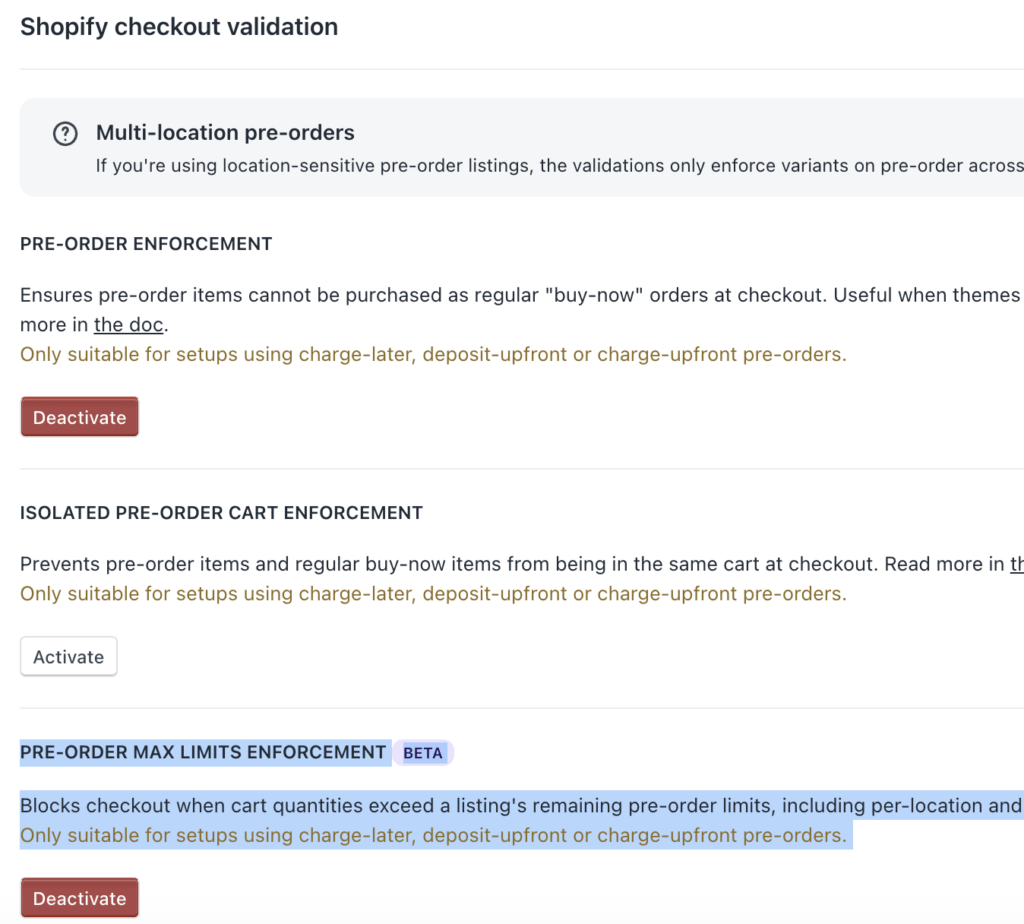
Pre-order max limits enforcement is now in beta, blocking checkout when a cart exceeds a listing’s remaining allocation, including per-location and per-customer limits.
Split orders are in closed beta, separating charge-upfront pre-order items into their own order after a single checkout.
Bulk actions now show a live progress banner, so you can see how far a big email or charge run has actually got.
Customer details are editable from the pre-orders drawer, with shipping address edits on BigCommerce and WooCommerce.
Pre-order prices are now locked in variant by variant at the time of sale, so later catalogue price changes never move an existing pre-order’s reporting (charges would have always been accurate, as we pre-request the current state of the order).
Introduction
The last few weeks have been about one thing: making sure the pre-order rules you set in PreProduct actually hold up everywhere else. Limits that live in your dashboard are only useful if a customer can’t get past them at checkout. An order that mixes pre-order and ship-now items is only manageable if your 3PL can tell the two apart.
So most of what landed this July and August 2026 pushes your settings further out into the places where real orders happen: Shopify checkout, your order feed, your customer records and your fulfilment queue. Two of the bigger releases are in beta, and we’ve flagged which is which below.
Pre-order max limits enforcement at checkout
Max limits are not new. You’ve been able to cap how many units of a variant go on pre-order, cap those units per location and cap how many units a single customer can take. What’s new is that Shopify checkout now enforces them.
Turn it on and PreProduct keeps a running count of remaining units on your product, which a Shopify checkout validation reads on every cart. If someone tries to check out with more units than are left, checkout is blocked with a clear message asking them to reduce the quantity.
The enforcement follows the same rules your listing does. Buy-now lines are ignored, so only actual pre-order lines count against an allocation. Location rows are matched on the delivery country, an exact country match beats a rest-of-world row, and where more than one row serves a country the strictest remaining number wins. Your max units per customer limit is checked against the whole cart for that product.
The checkout message is translated into eight languages, so an international customer sees it in their own language.
Where to find it
Setup, then the Shopify checkout validation card. It sits alongside pre-order enforcement and isolated cart enforcement, and it carries a Beta badge. You’ll need your app permissions up to date for checkout validations, and PreProduct will prompt you if they aren’t.
Availability
Shopify only, in beta. It’s built for charge-later, deposit-upfront or charge-upfront pre-orders that use fulfilment holds. Capture-only listings are not covered. There’s more detail in the enforcement doc.
Split orders for charge-upfront pre-orders
Mixed carts are the classic pre-order ops headache. A customer buys a t-shirt that’s in stock and a jacket that ships in October, pays for both up front, and now you have one order that your warehouse can neither ship nor sit on.
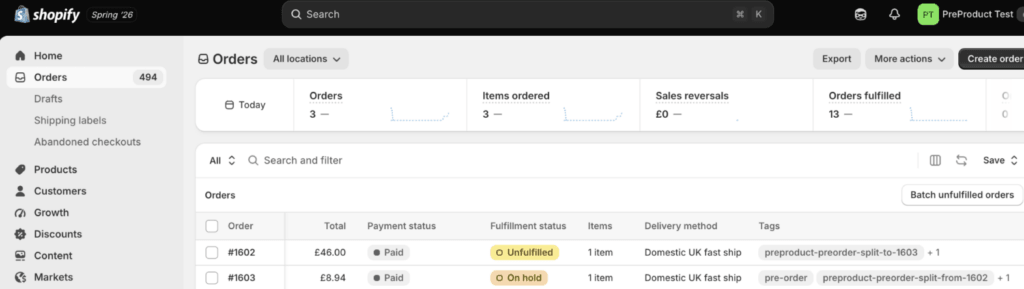
Split orders take a different route to the isolated cart redirects you may already use. Instead of forcing two checkouts, the customer checks out once, and PreProduct then moves the pre-order lines into their own separate order behind the scenes. The original order keeps the ship-now items and can go straight out. The new pre-order order is tagged, linked back to the original by order number and placed on a fulfilment hold until you release it.
No money moves during the split. The pre-order lines are written off the original order without refunding the customer, so the charge they already approved stays exactly as it was.
There are guardrails. Splitting only runs on fully paid orders with a shipping delivery method, it skips orders created by hand from a draft, and if anything about an order means it can’t be reconstructed cleanly, PreProduct leaves it alone rather than making a mess of it.
Availability
Shopify only, closed beta, and it only affects charge-upfront pre-orders. You’ll find the toggle under Setup, in the front-end redirects section, labelled “Split pre-orders into their own order after checkout”. If it’s greyed out, you’re not in the beta yet. We’d strongly suggest reading the splitting orders doc and testing before you go live, then emailing hello@preproduct.io to apply.
Progress banners on bulk actions
Bulk actions once meant crossing your fingers. You’d trigger charges on 400 pre-orders, the page would carry on as normal, and you’d refresh a few times hoping something was happening.
Now a banner appears at the top of the page with a live count: “Triggering charges in background. 47 of 412 processed”. It updates every few seconds and clears itself when the run finishes, refreshing the page so you see the final state.
The banners cover the bulk runs that take the longest:
Bulk creating listings and bulk finishing listings from the Listing Manager
Payment and charge runs triggered from a listing’s pre-orders page
Update emails and failed charge emails
The metafield sync that runs when you activate a checkout validation
The counts are deliberately cosmetic. If the progress tracking ever hiccups it can’t fail or retry an email or a charge, and the counters true themselves up from your actual pre-order data rather than drifting.
Availability
Shopify, BigCommerce and WooCommerce.
Customer details, editable from your pre-orders
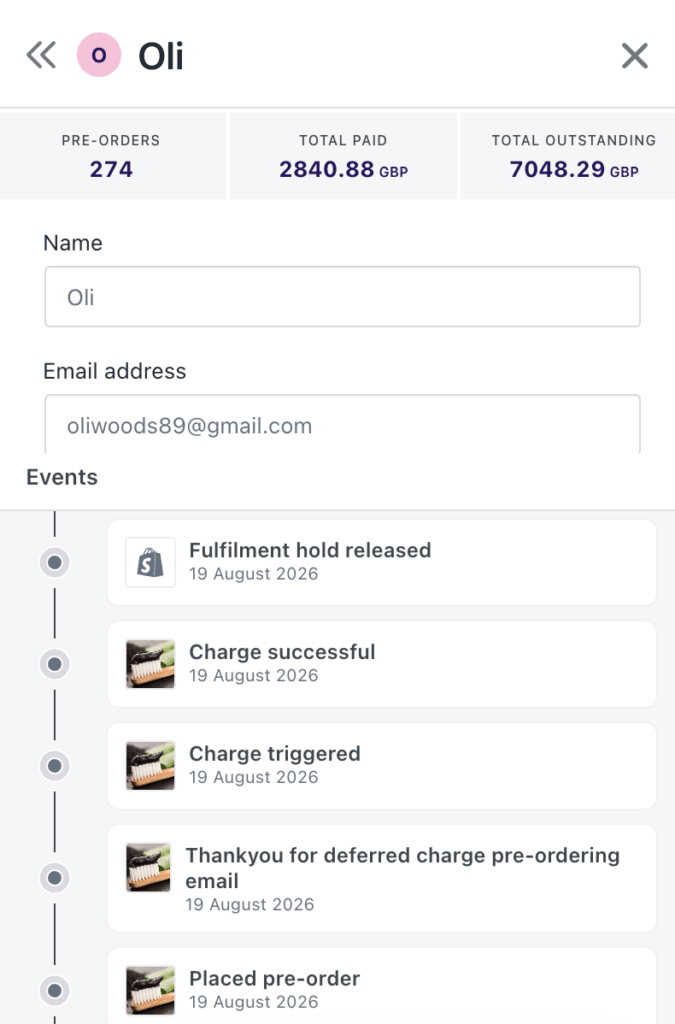
Click a customer’s avatar on any pre-order and you now get a proper customer drawer rather than a name and an email address.
At the top there are three numbers: how many pre-orders that customer has with you, what they’ve paid so far and what’s still outstanding across all of them. Below that, their name and email are editable in place. Change either and PreProduct applies it across every pre-order that customer holds at your store, so you’re not fixing the same typo eight times. If you’re connected to Stripe, the change is pushed to their Stripe customer record too, which matters when a charge-later email is going to land in the corrected inbox months from now.
Underneath sits their event timeline, so you can see what’s already been sent and charged without leaving the drawer.
Shipping address edits on BigCommerce and WooCommerce
On BigCommerce and WooCommerce, where the order is created in your platform at charge time rather than at checkout, you can also correct the shipping address from the same drawer. It applies to every one of that customer’s orders that hasn’t been pushed to your platform yet, and syncs to Stripe. Once an order has been pushed, PreProduct tells you so rather than letting you edit something that’s already left the building.
Availability
The customer drawer and profile editing work across Shopify, BigCommerce and WooCommerce. Shipping address editing is BigCommerce and WooCommerce only, because on Shopify the order already exists and is edited there.
Pre-order pricing reporting now captures a snapshot
Pre-orders have always charged the right total, we check against the e‑commerce platform’s order record before taking payment, so you won’t ever overcharge because a variant price changed later.
What’s new is that we now store each variant’s price at the time of sale (not just the order total). That means any reporting, and any emails that reference line item / variant prices, will match what the customer actually committed to, even if you reprice products, add variants, or restructure the listing before a charge-later or deposit balance is collected.
Discounts still apply on top at charge time, from the terms the pre-order captured, so a listing discount behaves exactly as the customer was shown. This mostly matters if you charge later, split charges across variants or run listings that stay live for months. If you charge everything up front, you won’t notice a difference, which is the point.
Availability
Shopify, BigCommerce and WooCommerce.
Listings now tidy up after themselves
If you delete a pre-order purchase option in your Shopify admin, or detach a product from one, PreProduct now hears about it and finishes the affected listings automatically.
Before this, a deleted selling plan group left listings looking active in PreProduct with nothing behind them on Shopify, which is a confusing state to debug. Now the listing finishes cleanly and your dashboard matches what Shopify actually has.
Availability
Shopify only.
Smaller improvements
Click the product image on the listing dashboard to jump straight from a listing to its live product page.
Checkout validation activation now shows its own progress banner while your product data syncs.
Checkout limit messaging ships translated into eight languages out of the box.
Wrapping up
The theme this time is trust in your own settings. A limit that holds at checkout, a mixed order that arrives at your warehouse already split, a price that stays put and a customer record you can fix in one place. None of it is flashy, all of it is the sort of thing that quietly stops a launch week going sideways.
Two of these are in beta, so if split orders or checkout limit enforcement would change how you run pre-orders, get in touch and we’ll talk through whether your setup is a fit.