10 Shopify Apps Every Brand Should Stack in 2026
Guest post from Akinwale Ojo of Zipchat.ai
TL;DR
Pre-order brands win on three things: speed, trust, and AOV. This list pairs the best Shopify apps for each piece, from deposit-taking checkout to AI support that runs while customers wait.
PreProduct is our top pick for the pre-order checkout layer. Zipchat is our top pick for AI chat. Stack the two, and the launch holds together from order to ship.
How We Picked These 10 Apps
Pre-order is its own model. The cash lands weeks or months before the goods do, and the support load lives in that gap.
We picked apps that hold up across the three jobs in the title: AOV, support, and launch speed. Each one had to install on Shopify in under an hour, work with deferred billing or a delayed ship date, and earn its slot from public Shopify App Store or G2 reviews. We scored on fit for pre-order workflows first, then price, then how well the app plays with the rest of a Shopify stack.
The 10 Apps at a Glance
| # | App | Best for | Starting price | Rating | Why it earns the slot |
| 1 | PreProduct | Pre-order checkout + deposits | $59.99/month | 4.9/5 | Native Shopify checkout, deposit logic, deferred billing |
| 2 | Zipchat | AI customer support 24/7 | $49/month | 4.9/5 | Handles the “when will it ship?” wave on autopilot |
| 3 | Back in Stock by Swym | Waitlists + restock alerts | $19.99/month | 4.7/5 | Captures demand before the next drop |
| 4 | Klaviyo | Email + SMS for launches | Custom-based pricing | 4.7/5 | Deepest segmentation for pre-order lifecycles |
| 5 | AfterShip | Tracking + delay comms | $29/month | 4.5/5 | Cuts “where is my order” tickets in half |
| 6 | Growave | Loyalty + retention | $15/month | 4.8/5 | Rewards and VIP early access keep pre-order buyers coming back |
| 7 | ReConvert | Post-purchase upsells | $19.99/month | 4.6/5 | Lifts AOV on the thank-you page |
| 8 | Loop Returns | Returns + exchanges | $155/month | 4.7/5 | Exchanges keep revenue when pre-orders arrive late |
| 9 | Judge.me | Reviews + social proof | $15/month | 5.0/5 | Reviews soften the wait for new buyers |
| 10 | Kark Multi Location Inventory | Multi-location stock | $6.99/month | 5.0/5 | One stock record per location, ready for the drop |
1. PreProduct: Best for Pre-Order Checkout and Deposits
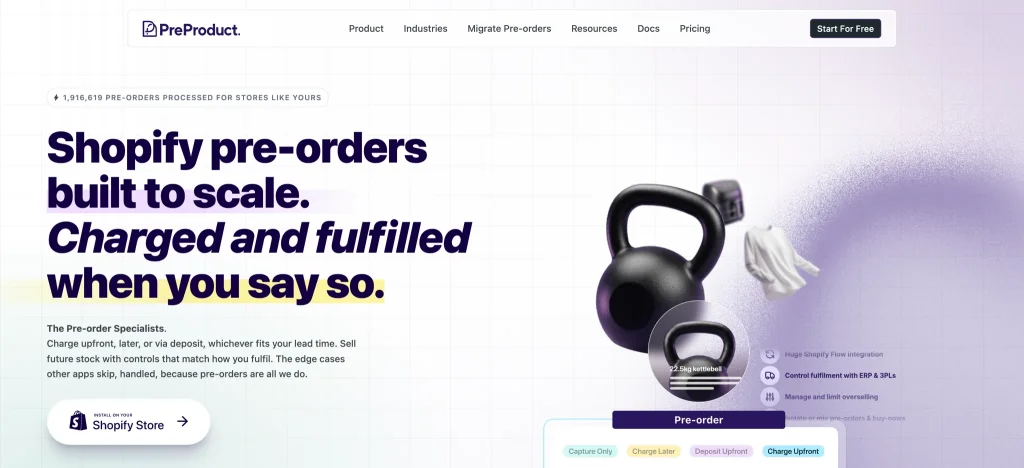
PreProduct is a Shopify-native pre-order app. It lets you take a deposit, charge in full at order, or hold the card and bill later. The whole flow stays inside Shopify checkout, so the buyer never sees a third-party page. Pre-order lines are held back from fulfillment until stock lands, so only what’s ready is released to ship.
Pre-order brands use it to protect cash flow when stock lands six or twelve weeks out. A 20% deposit holds the order, and the rest is charged when the goods are ready.
Key features
- Deposit, full payment, or pay-later pre-orders.
- Deferred charges on a vaulted card, triggered by hand or on automation.
- Mixed or pre-order-only carts, alongside in-stock products.
- Variant-level pre-order toggles.
- Built-in pre-order email comms.
- Controlled fulfillment: pre-order lines held back until stock lands, then released by listing, by customer or automatically as stock is added. Pre-order limits per variant and customer.
Pricing: Free Starter plan available (5% of paid pre-order revenue); paid plans from $59.99/month.
Rating: 4.9/5.
Pros
- Sits inside the native Shopify checkout.
- Deposit logic that does not need manual reconciliation.
- Built for brands shipping four to sixteen weeks after order.
Cons
- Email comms inside the app are simpler than a dedicated ESP, so pair it with Klaviyo.
Best for: Brands running pre-orders at scale, from a seasonal launch or sold-out hero product to thousands of SKUs alongside in-stock items. Also deposit-led and made-to-order operations.
2. Zipchat: Best for AI Customer Support
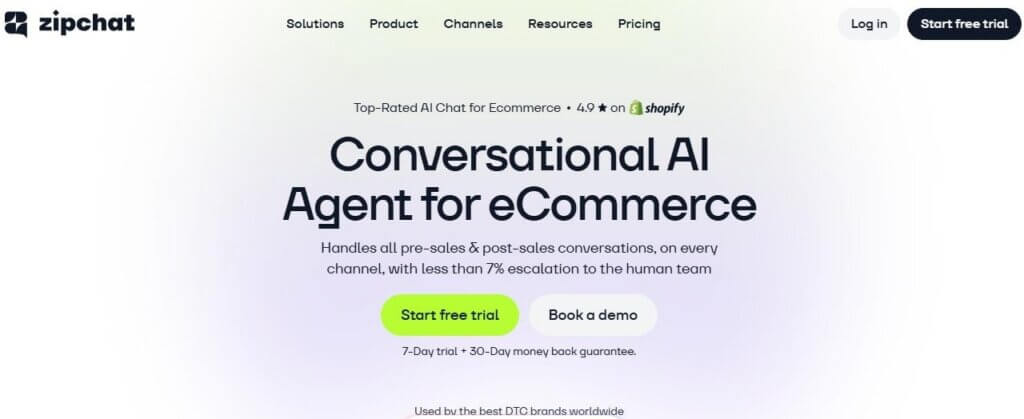
Zipchat is an AI sales and support agent built for Shopify. It reads your live catalog, order data, and policies, then answers shopper questions on a Shopify store, website, WhatsApp, Instagram, Messenger, and email.
Pre-order brands feel the support load most in the gap between order and ship. The same five questions repeat for weeks: when will it ship, can I change the size, will I be charged now, and can I cancel. Zipchat answers all five without a human.
When a customer asks for a different size that is sold out, the out-of-stock assistant recommends an alternative instead of dropping the conversation. When the buyer wants to cross-sell into a bundle, AI product recommendations handle it inside the chat.
Key features
- AI chat trained on your live catalog and policies.
- Order lookup and shipping status inside the chat.
- WhatsApp, Instagram, and Messenger in one inbox.
- 95+ languages, no translation work.
- Custom Tools to call your own APIs (CRM, WMS, ESP).
Pricing: Starts at $49/month with a free trial.
Rating: 4.9/5.
Pros
- Handles the WISMO wave that a pre-order launch always produces.
- Recovers carts before checkout, not after.
- Tied to the live catalog, so it does not invent stock answers.
Cons
- Brands that prefer a human-first inbox will want a clear escalation rule from day one.
Best for: Pre-order brands with global buyers, long shipping windows, and a small support team that cannot run 24/7.
3. Back in Stock by Swym: Best for Waitlists and Stock Alerts
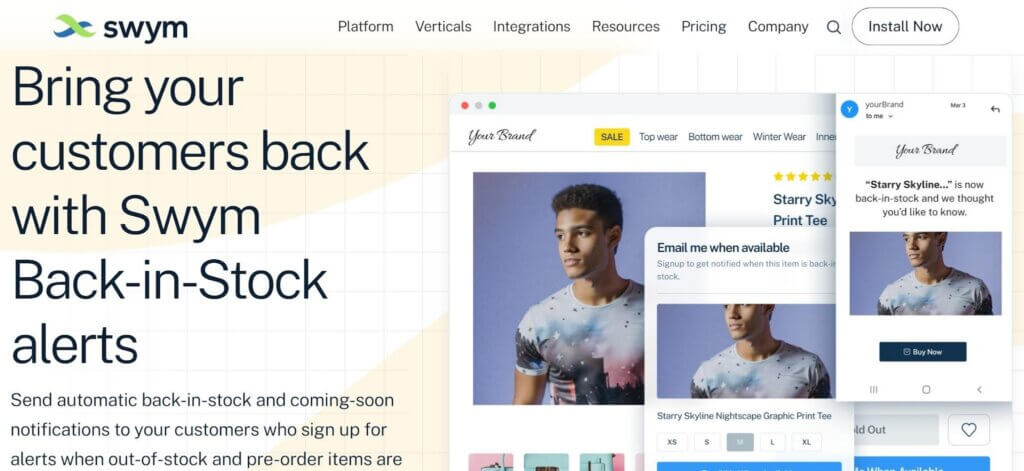
Back in Stock by Swym lets shoppers sign up for a stock alert when an out-of-stock product returns. For pre-order brands, this is the demand-capture layer that sits next to the pre-order toggle.
The app sends restock alerts by email or SMS, integrates with Klaviyo, and feeds intent data into your next drop forecast.
Key features
- Notify-me form on every product page.
- Email and SMS alerts on restock.
- Klaviyo, Shopify Email, and Mailchimp integrations.
- Per-variant waitlist tracking.
- Demand data export for forecasting.
Pricing: Starts at $19.99/month.
Rating: 4.7/5.
Pros
- Captures buyers who would otherwise leave.
- Variant-level lists tell you which size or color sold out fastest.
- Light setup, often under thirty minutes.
Cons
- The free plan caps alerts, which is tight for high-traffic stores.
Best for: Pre-order brands that drop in waves and want a hard signal on what to order next.
4. Klaviyo: Best for Launch Email and SMS
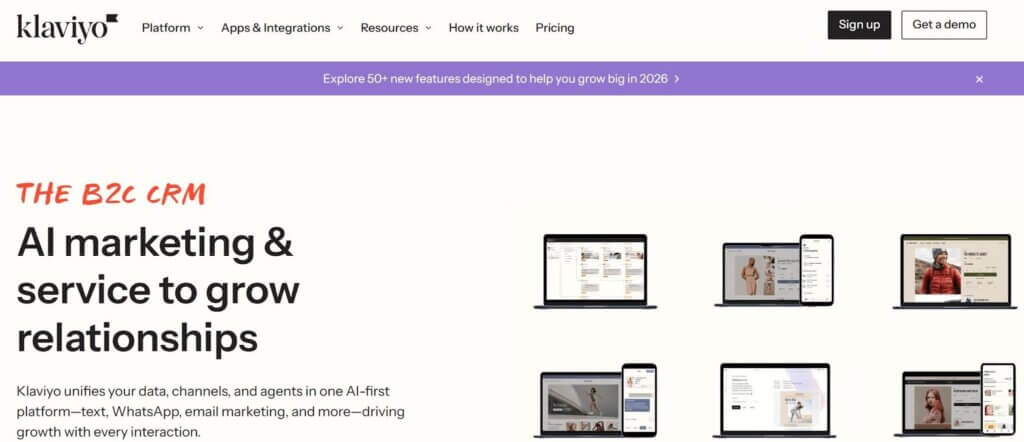
Klaviyo is the marketing engine most pre-order brands run on. Email, SMS, and reviews from a single contact record. The reason it works for pre-order is segmentation. You can split buyers by ship window, by deposit status, or by which drop they signed up for.
A clean pre-order flow keeps the buyer warm for the eight weeks between order and delivery, which is when most refund requests happen.
Key features
- Drag-and-drop email and SMS flows.
- Pre-built pre-order flow templates.
- Segmentation by purchase date, product, and ship window.
- A/B testing on subject lines and SMS copy.
- Reviews capture in the same tool (Klaviyo Reviews).
Pricing: Free plan available; custom-based pricing.
Rating: 4.7/5.
Pros
- Deepest segmentation in the Shopify ESP space.
- One platform for email, SMS, and reviews.
- Strong template library for product launches.
Cons
- The pricing curve is steep above 50,000 contacts.
Best for: Brands that build hype before the drop and need to nurture buyers through a long ship window.
5. AfterShip: Best for Tracking and Delay Comms
AfterShip turns the post-purchase wait into a branded experience. It pulls tracking data from 1,100+ carriers and gives buyers a page they can check without emailing support.
For pre-order, the magic is the delay comms. When a drop slips by a week, AfterShip can push a branded update by email and SMS so the buyer hears it from you first.
Key features
- Branded tracking page for every order.
- Carrier coverage across 1,100+ couriers.
- Delivery delay detection with proactive alerts.
- Estimated delivery date on the order page.
- Returns add-on (separate product) for full lifecycle.
Pricing: Starts at $29/month.
Rating: 4.5/5.
Pros
- Cuts WISMO tickets by half for most brands that install it.
- Branded tracking page replaces the bare carrier link.
- Works well alongside Zipchat as the data source for shipping questions.
Cons
- The free plan does not cover SMS alerts.
Best for: Pre-order brands shipping internationally where carrier delays are normal and proactive comms protect trust.
6. Growave: Best for Loyalty and Retention
Growave is an all-in-one retention platform for Shopify. It rolls loyalty points, VIP tiers, referrals, reviews, and wishlists into one app, so you are not stitching four tools together to keep customers coming back.
For pre-order brands, loyalty is how you turn a one-off deposit into a repeat buyer. Reward points for placing a pre-order, give VIP tiers early access to the next drop, and let wishlists capture who wants the product before it is live. The wait becomes part of the relationship instead of a reason to churn.
Key features
- Loyalty points, rewards, and VIP tiers with store credit.
- Referral programs with fraud protection.
- Product reviews with AI summaries.
- Wishlists with back-in-stock alerts.
- Integrations with Klaviyo, Shopify Flow, Gorgias, Recharge, and Shopify POS.
Pricing: Free plan available (up to 200 orders/month); paid plans start from $15/month.
Rating: 4.8/5.
Pros
- Replaces several single-purpose apps with one dashboard.
- VIP tiers and early access suit drop-based pre-order launches.
- Built for Shopify, with checkout and customer account extensions.
Cons
- Pricing is tied to monthly order volume, so costs climb as you scale.
Best for: Brands that want to turn pre-order buyers into repeat customers and reward the community that backs each launch.
7. ReConvert: Best for Post-Purchase Upsells
ReConvert sits on the Shopify thank-you page and turns it into a second revenue moment. Buyers who already gave you a card are far more likely to add a low-friction item.
For pre-order, the play is to bundle a fast-shipping accessory with the long-lead-time main product. The accessory ships in three days. The buyer feels progress while they wait for the drop.
Key features
- One-click post-purchase upsells.
- Thank-you page builder with drag-and-drop.
- Survey blocks to learn why a buyer chose you.
- Birthday capture for next-year remarketing.
- Funnel analytics on accepted vs declined offers.
Pricing: Starts at $19.99/month.
Rating: 4.6/5.
Pros
- The lowest-effort AOV lift on the list.
- Pre-built funnels you can ship in under an hour.
- The free plan is enough to test the model.
Cons
- Best results need a fast-shipping SKU to pair with the pre-order item.
Best for: Pre-order brands that have a small range of in-stock add-ons (stickers, cleaning kits, accessories) to attach to the main drop.
8. Loop Returns: Best for Returns and Exchanges
Loop Returns is built around one idea: keep the revenue. Instead of pushing every return into a refund, the portal steers shoppers toward an exchange or a credit.
That matters for pre-order. When a drop ships late or the fit is wrong, Loop holds the dollars inside your store. A 30% exchange rate on returns is the difference between a refund line and a fresh order.
Key features
- Self-serve returns portal for shoppers.
- Exchange-first logic with bonus credit options.
- Workflow rules by SKU, country, or order date.
- Carrier label generation with discounted rates.
- Reports on return reason and exchange rate.
Pricing: Starts at $155/month.
Rating: 4.7/5.
Pros
- Exchange-first design holds revenue better than refund-default tools.
- Strong fit for fashion, footwear, and home, where size returns are normal.
- Cuts manual ops time on every return.
Cons
- Pricing is steep for sub-$1M brands.
Best for: Pre-order brands at scale where one in five orders comes back and the exchange rate moves the P&L.
9. Judge.me: Best for Reviews and Social Proof
Judge.me is the most-installed review app on Shopify for a reason. It is fast, it is cheap, and it ships every feature most brands need on day one.
For pre-order, reviews from a past drop hold the next launch together. A shopper deciding to wait twelve weeks needs proof that the last batch arrived in good shape.
Key features
- Photo and video reviews.
- Star ratings on Google Shopping.
- Review request emails timed to delivery.
- Q&A widget for product pages.
- Multilingual reviews.
Pricing: Free plan available; paid plans start from $15/month.
Rating: 5.0/5.
Pros
- Free plan covers most pre-order brands until they scale.
- Review request timing can be set to “after delivery,” not “after order”.
- Reviews flow into Google Shopping with one toggle.
Cons
- The look is plain. Brands with strong design teams may want more theme control.
Best for: New and growing pre-order brands that need social proof on the cheap before the next drop.
10. Kark Multi-Location Inventory: Best for Multi-Location Stock
Kark Multi Location Inventory is built for Shopify brands with stock spread across several warehouses or stores. It holds one record per SKU per location, in real time, and feeds the storefront the right number on every product page.
For pre-order, the value lands on drop day. When the inventory hits the dock, Kark routes it to the right region, and the chat layer (Zipchat reads from this same feed) tells global buyers exactly what is shipping from where.
Key features
- Real-time stock per location.
- Multi-warehouse and retail location support.
- Native Shopify inventory integration.
- Per-location product page badges.
- Reports on regional sell-through.
Pricing: Starts at $6.99/month.
Rating: 5.0/5.
Pros
- Clean single feed for downstream tools (AI chat, ESP, returns).
- Built for brands with two to ten locations, not single-warehouse setups.
- Cuts manual stock reconciliation across regions.
Cons
- Single-warehouse brands will not feel the gain.
Best for: Pre-order brands with two or more fulfillment locations and global buyers who ask, “Is it shipping from my country?”
How To Choose Your Pre-Order Stack
You do not need all ten apps on day one. Most brands grow into the stack over two or three quarters.
A simple rule works here.
| Stage | Annual revenue | Apps to install first |
| Launching | Under $500k | PreProduct, Zipchat, Back in Stock, Klaviyo |
| Scaling | $500k to $5M | Add AfterShip, ReConvert, Judge.me, Growave |
| Mature | $5M+ | Add Loop Returns, Kark |
Three filters help when you pick between two apps in the same slot.
Filter 1: Does it cover the pre-order wait? A tool that ignores the four-to-twelve-week ship gap will not earn its slot on a pre-order brand. Test by asking the vendor how the app handles a delayed ship date.
Filter 2: Does it work with Shopify checkout? Apps that pull buyers off the native checkout cost conversion. Push hard on this.
Filter 3: Can it run while you sleep? Pre-order brands sell globally. AI chat, branded tracking, and waitlist alerts have to run on their own.
When This Stack Fails
The stack is not magic. Three patterns kill the ROI even when every app is installed.
The stack is bigger than the team. Five apps with five dashboards and no owner is a recipe for ignored alerts. Pick one operator to own the stack and review it weekly.
The data is not joined up. If Klaviyo, Zipchat, and AfterShip pull from different order records, the buyer gets three answers to the same question. Run one source of truth (Shopify) and let the apps read from it.
The ship date keeps slipping. No app fixes a broken supply chain. If the drop date moves three times, the trust loss is bigger than any tool can recover. Be honest in the comms, refund fast when you have to, and rebuild on the next launch.
A working threshold for a pre-order stack: ticket volume under five percent of orders, refund rate under three percent of pre-orders, and at least one in three returns turned into an exchange.
Conclusion
The cleanest pre-order opener is two apps: PreProduct for the checkout and Zipchat for the support layer. PreProduct holds the deposit and the ship window. Zipchat answers every “when will it land” question that the wait produces. Together, the buyer feels held from order to delivery.
Add the rest as orders grow. The stack pays back when the launch lands clean and the ship window stays quiet.
Try Zipchat free or book a demo.
FAQs
What is the best Shopify store app for pre-orders in 2026?
PreProduct is our top pick for the pre-order checkout layer. It handles charge-upfront, charge-later and deposit pre-orders inside Shopify’s native checkout, then holds pre-order lines from fulfillment until stock lands. Pair it with Zipchat for support, Klaviyo for email and SMS, and AfterShip for shipping comms.
Do I need a separate app for pre-orders, or can Shopify handle it?
Shopify’s native pre-order options are basic. They mark a product as “pre-order” but do not handle deposits, deferred billing, or pre-order-specific email flows. For anything beyond a one-off campaign, a dedicated app pays back fast.
How do I cut support volume on a pre-order launch?
Two moves help most. First, install an AI chat like Zipchat that reads your live catalog and order data, so it can answer “when will it ship” without escalating. Second, install AfterShip to give buyers a branded tracking page and proactive delay alerts.
Does AI chat work for pre-order brands?
Yes, when the AI reads the live order and catalog data. Zipchat handles the WISMO wave that follows every pre-order launch, answers in 95+ languages, and recommends alternatives when a size sells out. Read more in our guide to the best AI chatbot for Shopify.

Akinwale Ojo
Content Strategist @Zipchat.ai
Akinwale Ojo is a Content Strategist with over six years of experience in SEO and technical content writing. He helps B2B, B2C, and SaaS companies grow through data-driven content strategies, turning complex product insights into search-optimized articles that improve organic visibility, support lead generation, and strengthen brand positioning.
Pre-sell With PreProduct
7 day free trial with all plansMigrate pre-orders
