How to Run a Pre-order Campaign: Complete Guide for Ecommerce Brands
A pre-order campaign is more than just flipping a switch and hoping customers find your product. It’s a coordinated effort to build anticipation, capture demand, and generate revenue before your inventory even arrives. Yet most merchants treat pre-orders as an afterthought, missing out on the strategic advantages that come from proper campaign planning.
The difference between “having pre-orders enabled” and “running a pre-order campaign” can be significant. A coordinated launch concentrates demand into a defined window, creating momentum that builds on itself. That kind of energy doesn’t happen by accident. It comes from deliberate marketing, clear communication, and a phased approach that builds excitement before launch day.
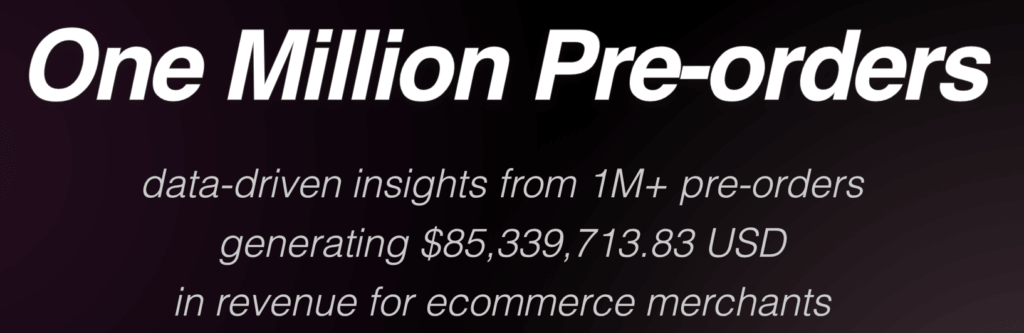
This guide breaks down exactly how to plan and execute a pre-order campaign from start to finish. We’ll cover everything from choosing the right payment model to post-campaign analysis, backed by insights from over $85 million in pre-order sales.
What Is a Pre-order Campaign?
A pre-order campaign is a structured marketing effort designed to sell products before they’re available to ship. Unlike simply enabling pre-orders on your store, a campaign involves deliberate phases: building anticipation, launching with momentum, sustaining interest through the pre-order window, and following through with clear communication until fulfillment.
Pre-order campaigns make sense in several scenarios:
- New product launches where you want to validate demand before committing to large inventory orders
- Restocks of popular items where you know demand exists but need time to replenish
- Limited edition releases where scarcity and exclusivity drive urgency
- Seasonal products where timing matters and you need to capture intent early
- Made-to-order items where production only begins after orders come in
The key distinction is intentionality. A campaign has a beginning, middle, and end. It has marketing assets, email sequences, and clear timelines. It treats the pre-order period as an opportunity rather than an inconvenience.
Why Run a Pre-order Campaign Instead of Just Enabling Pre-orders?
Merchants who treat pre-orders as campaigns rather than features see better results across multiple dimensions.
Revenue concentration matters. When you launch with coordinated marketing, you compress demand into a shorter window. This creates visible momentum that feeds on itself. Customers see other people buying, which validates their decision to purchase. Social proof builds naturally when you have a defined launch moment.
Demand forecasting becomes more accurate. A campaign gives you a cleaner signal of actual demand. Instead of trickling orders over weeks or months, you get a concentrated burst that helps you understand how many units you’ll actually sell. This informs production decisions, inventory planning, and future marketing spend.

Customer acquisition costs can decrease. When you build anticipation before launch, your audience is primed to convert. Email subscribers who’ve been warmed up convert at higher rates than cold traffic. Influencer partnerships generate more impact when coordinated around a specific launch date rather than an evergreen availability.
Brand building compounds. Successful pre-order campaigns become part of your brand story. Customers remember being part of a launch. They share their excitement on social media. They become advocates who bring others into your next campaign.
The data supports treating pre-orders as strategic opportunities. Our analysis of 1 million+ pre-orders reveals patterns in payment models, pricing, and timelines that successful merchants use to optimize their approach.
Phase 1: Pre-Campaign Preparation (4-6 Weeks Before Launch)
The work you do before opening pre-orders determines how successful your campaign will be. This preparation phase covers three critical areas: payment model selection, timeline setting, and asset creation.
Choose Your Payment Model
Your payment model affects customer psychology, cash flow, and operational complexity. There’s no universally right answer; the best choice depends on your specific situation.
Charge upfront works best when:
- Your lead time is relatively short (under 30 days)
- You have established trust with your audience
- You need cash flow immediately to fund production
- You’re offering limited quantities where demand certainty matters
Charge later (collecting payment at shipping) works best when:
- Your lead time is longer or uncertain
- You’re launching a new product where customers may be hesitant
- You want to maximize pre-order volume by reducing purchase friction
- You’re comfortable with the operational complexity of deferred charging
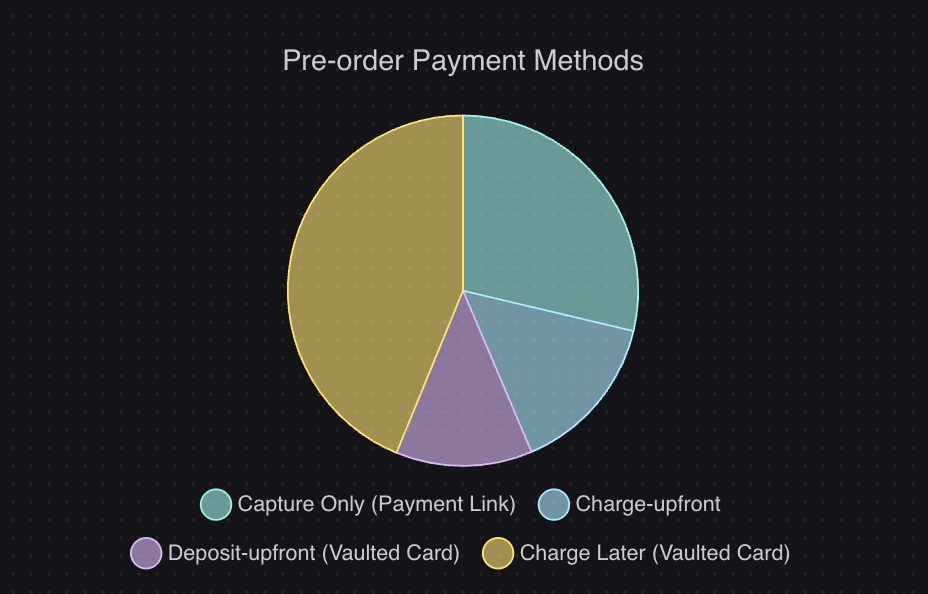
According to our data, 43.8% of pre-order listings use charge-later payment models. This suggests many merchants find that reducing upfront commitment increases total pre-order volume.
Deposits (partial payment now, balance at shipping) work best when:
- You’re selling higher-ticket items where full payment feels risky
- You want some commitment without the full friction of charge-upfront
- You need partial cash flow now but don’t want to charge the full amount
For a deeper comparison of these approaches, see our complete guide to pre-order payment models.
Set Realistic Timelines
Nothing damages a pre-order campaign like missed shipping dates. Customers are surprisingly patient when expectations are set correctly from the start. They become frustrated when promises are broken.
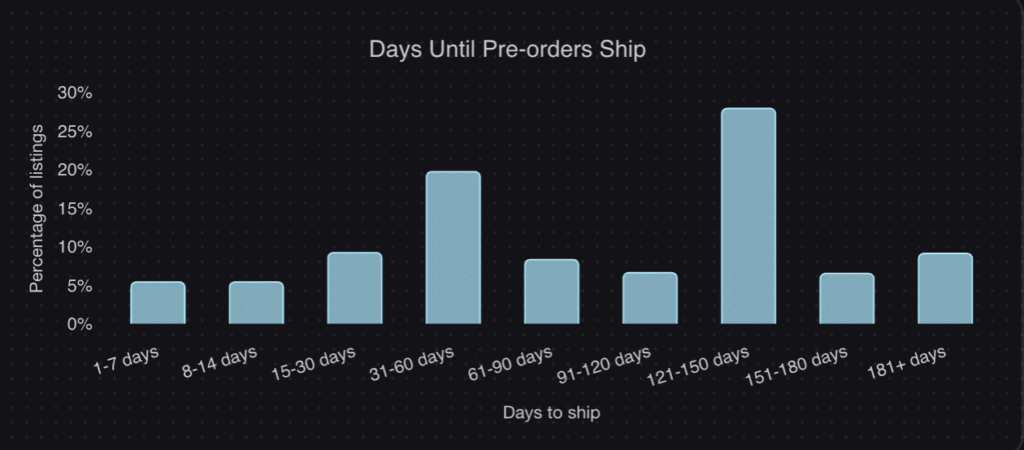
Our data shows that the most common shipping timeframe for pre-orders is 121-150 days, representing 28.1% of all pre-orders. This tells us that customers are willing to wait several months for products they want, as long as they know what to expect.
Best practices for timeline setting:
- Add buffer to your estimates. If your manufacturer says 8 weeks, tell customers 10-12 weeks. Under-promising and over-delivering builds trust.
- Plan for delays. Manufacturing issues happen. Have a communication plan ready for if (when) timelines slip.
- Be specific when possible. “Ships in Q2” is less compelling than “Ships week of May 15th.” Specificity signals confidence (although this needs to be balanced with the need for the last point!)
- Account for shipping transit time. Your timeline should reflect when customers receive products, not when you ship them.
The gap between pre-order open and delivery should be reflected in your pre-order policy. For example, a pre-order with a 6 month ETA should probably be a charge-later or deposit listing. Where as charging upfront for a pre-order shipping in two weeks is absolutely fine.
Build Your Marketing Assets
Before launch day, you need everything ready to go:
Product photography and video. Even if your final product isn’t ready, you need compelling visuals. Factory samples, 3D renders, or prototype images work fine as long as you’re transparent that final products may vary slightly.

Landing page or product page. Your pre-order product page needs to clearly communicate that this is a pre-order, when customers can expect delivery, and how payment works. Ambiguity creates support tickets and cancellations.
Email sequences. Draft your launch announcement, reminder emails, and post-purchase communication before you go live. You’ll want:
- Teaser emails for the weeks before launch
- Launch day announcement
- Mid-campaign reminders for those who haven’t purchased
- Order confirmation with clear pre-order terms
- Shipping updates as you approach fulfillment
For detailed guidance, see our pre-order email sequence guide.
Social content calendar. Plan your posts for each day of the campaign. Behind-the-scenes content, customer quotes, progress updates, and deadline reminders all keep momentum going.

Phase 2: Building Anticipation (2-4 Weeks Before Launch)
The pre-launch period is about priming your audience so they’re ready to buy the moment pre-orders open.
Email List Warm-up
Your existing subscribers are your most likely customers. Start warming them up:
- Tease the product. Share glimpses without revealing everything. Create curiosity.
- Offer early access. Let subscribers know they’ll get first dibs on pre-orders.
- Build a VIP list. Create a separate signup for people who want launch notifications. This segment is your highest-intent audience.
Social Media Seeding
Use social platforms to build buzz:
- Behind-the-scenes content showing product development, manufacturing visits, or design decisions
- Countdown posts as launch day approaches
- Influencer seeding by sending samples to creators who will share their honest reactions on launch day
Pre-launch Landing Page
If you’re not ready to take pre-orders yet, create a coming soon page that captures email addresses. This builds your launch list while creating a sense of anticipation. Include:
- Product imagery
- Brief description of what’s coming
- Expected launch date
- Email signup form
- Social proof if available (press mentions, early reviews, etc.)

Phase 3: Campaign Launch (Days 1-7)
Launch day is your biggest opportunity for momentum. Concentrate your efforts here.
Launch Day Execution
Everything should fire simultaneously:
- Email blast to your full list, with VIP early access going out slightly earlier if you offered it
- Social media announcement across all platforms
- Influencer activation with coordinated posts from creators who received samples
- Paid advertising launch if you’re running ads, start them now to capture the launch momentum
The goal is creating the feeling that something is happening. When customers see activity across multiple channels, social proof kicks in.
First Week Momentum
Keep the energy going through week one:
- Daily social updates showing order counts, customer reactions, or production progress
- User-generated content requests asking customers to share their purchase excitement
- Progress tracking like “500 units claimed, only 200 remaining” creates urgency without being manipulative (as long as numbers are real)
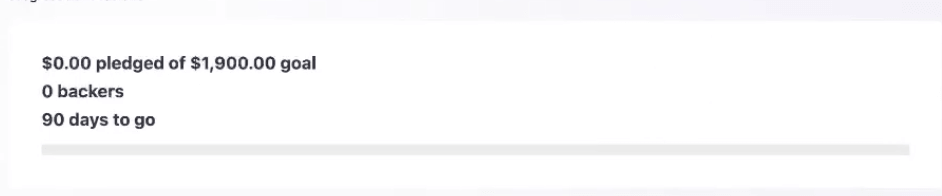
Consider adding a crowdfunding-style progress bar to your product page. Visual progress indicators tap into the same psychology that makes Kickstarter campaigns compelling.
Phase 4: Mid-Campaign Management (Week 2+)
After the initial launch burst, maintaining momentum requires consistent effort.
Maintaining Momentum
- Weekly email updates to your list highlighting progress, new testimonials, or behind-the-scenes content
- New angles and content that give you fresh reasons to reach out to your audience
- Genuine scarcity messaging if you have limited quantities or a deadline approaching
The key is providing value with each touchpoint, not just asking for the sale repeatedly.
Customer Communication
For customers who have already pre-ordered:
- Order confirmation with crystal clear terms on when they’ll be charged (if charge-later) and when they’ll receive products
- Shipping timeline reminders as you approach the estimated date
- Production updates if you have interesting progress to share
Good communication during the pre-order period reduces cancellations. Our data shows an average cancellation rate of 5.4%. Merchants who communicate proactively typically see rates below this average.

Phase 5: Campaign Close and Post-Launch
Closing the Campaign
If your pre-order has a deadline:
- Last chance messaging in the final 48-72 hours creates urgency
- Deadline reminders via email and social media
- Final conversion push with any remaining incentives you’re offering
Be specific about what happens when the deadline passes. “Pre-orders close Sunday at midnight” is more compelling than “pre-orders ending soon.”
Post-Campaign Analysis
After your campaign closes (or after you fulfill and ship), review your performance:
- Pre-order conversion rate: What percentage of product page visitors placed pre-orders?
- Email signup to pre-order conversion: How many of your launch list actually bought?
- Average order value: Did bundling or upsells work?
- Cancellation rate: How does yours compare to the 5.4% average?
- Time to charge (if charge-later): How long between order and payment collection?
- Payment success rate: Did deferred charges go through smoothly?
If you experience failed charges during collection, our guide on recovering failed Shopify payments covers dunning strategies and best practices (for example, PreProduct has a failed charge flow that can be initiated).
Pre-order Campaign Metrics That Matter
Track these KPIs to optimize future campaigns:
Conversion metrics:
- Pre-order page conversion rate
- Email click-to-purchase rate
- Ad ROAS for pre-order campaigns
Financial metrics:
- Average order value
- Revenue per email subscriber
- Cost per pre-order acquisition
Operational metrics:
- Cancellation rate
- Support ticket volume
- Charge success rate (for deferred payment models)
Engagement metrics:
- Email open and click rates throughout campaign
- Social engagement on pre-order announcements
- Referral/share rates
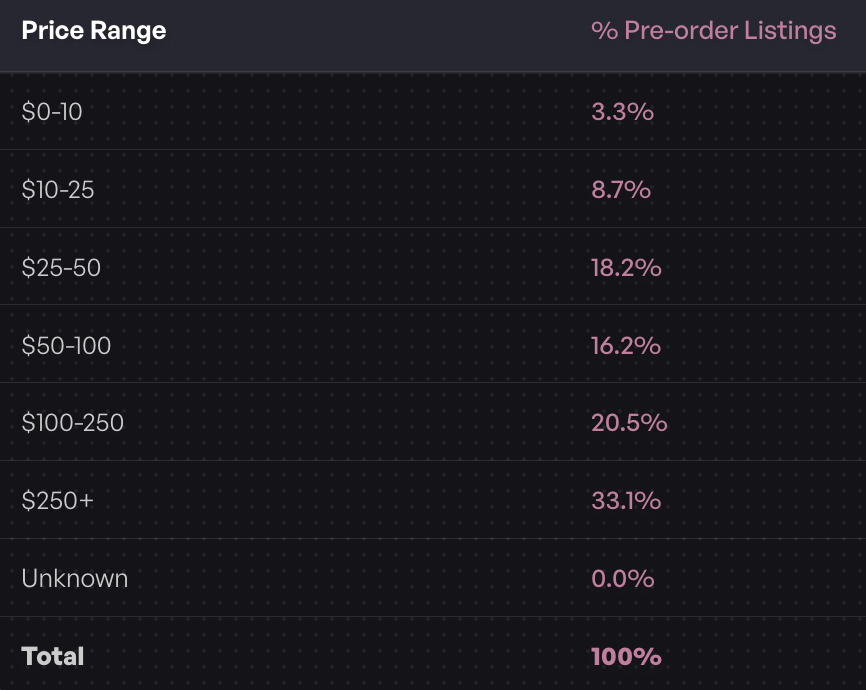
For benchmarks on pricing and other factors, our 1M pre-orders report shows that the most common price range for pre-order products is over $250, representing 26.8% of listings. This suggests pre-orders work particularly well for higher-ticket items where customers are willing to wait for quality.
Common Pre-order Campaign Mistakes to Avoid
1. Not communicating delivery timelines clearly. Vague shipping estimates create customer anxiety and support burden. Be as specific as possible, and if anything changes, communicate immediately.
2. Overpromising and under-delivering. Whether it’s product features, quality, or timing, broken promises destroy trust. It’s better to launch with realistic expectations than to set yourself up for disappointment.
3. Missing early-bird incentives. Give customers a reason to buy now rather than later. Limited-time pricing, exclusive bonuses, or early access to future products can compress your sales into the launch window.
4. Ignoring post-purchase communication. The sale isn’t over when someone pre-orders. Keep customers engaged and informed throughout the waiting period. Silence breeds anxiety and cancellation requests.
5. Not having a cancellation recovery plan. Some cancellations are inevitable. Have a process for handling them gracefully, and consider whether you can win back cancelled customers with future offers.
Pre-order Campaign Ideas by Industry
Different product categories call for different approaches.
Fashion and Apparel
- Seasonal collection drops where the entire collection launches on pre-order before production
- Limited colorways available only through pre-order
- Collaboration pieces with designers or influencers
- Made-to-order models that reduce waste and overproduction
Consumer Electronics and Gadgets
- New product launches where pre-orders fund production runs
- Next-gen product releases before current inventory is depleted
- Founder’s edition packaging or features exclusive to pre-order customers
Food and Beverage
- Seasonal products (holiday items, limited flavors)
- New flavor launches with exclusive early access
- Subscription box previews where subscribers get first access to new products
Home Goods and Furniture
- Custom/made-to-order pieces where production begins after order
- New collection launches before warehouse stock arrives
- Exclusive finishes or materials available only through pre-order
For more pre-order best practices across industries, we’ve compiled data-driven strategies from merchants running successful campaigns.
Conclusion
Running a successful pre-order campaign is where you do more than just enable ‘pre-order’ on your store. It’s where you put in intentional planning across five phases: preparation, anticipation-building, launch, mid-campaign management, and post-campaign analysis.
The merchants who see the best results treat pre-orders as strategic marketing events rather than operational necessities. They choose payment models that match their business needs, set realistic timelines with built-in buffer, and communicate consistently throughout the customer journey.
Key takeaways:
- Start preparing 4-6 weeks before you want to open pre-orders
- Choose a payment model based on your lead time and customer trust level
- Build anticipation through email warm-up and social seeding before launch
- Concentrate marketing efforts on launch day for maximum momentum
- Communicate proactively with customers throughout the waiting period
- Analyze results to improve future campaigns
If you’re running pre-orders on Shopify, tools like PreProduct can help you manage payment collection, customer communication, and fulfillment holds. But regardless of what tools you use, the principles remain the same: plan deliberately, launch with momentum, and communicate clearly.
Your next product launch deserves more than a passive pre-order button. Give it a campaign!
Pre-sell With PreProduct
7 day free trial with all plans